Get widget

News

All kinds of news around the world in one place!

Studies

Explore with us and enjoy in that!

Encyclopedia

Start with us a journey through world of knowledge!

Travel

The world is beautiful. Let's peek into some magnificent places, and see what they offer!

Entertainment

Fun - because we have the right to be happy!

Lifestyle

Our life is adventure. Enjoy in every moment of that!

TOP 10

Amazing lists of incredible things!

Dede Kosawa - 'Tree Man'

32 year old Dede Kosawa, also known as 'Tree Man', is one of the world's most extraordinary people. He lives in a remote village in Indonesia with his two children, trying to care for them. Dede, a former fisherman, has an incredible skin condition: he has root like structures growing out of his body - branches that can grow up to 5cm a year and which protrude from his hands and feet, and welts covering his whole body.

He is known locally as ‘Tree Man’ and his condition has baffled local doctors for 20 years. In an attempt to earn a living to support his family, he is part of a circus troupe, displaying his 'Tree Man' limbs along with others afflicted with skin deformities in ‘freak’ shows.

Dr Anthony Gaspari, a world expert in skin conditions from the University of Maryland travels to Indonesia to attempt to diagnose 'Tree Man' Dede’s mysterious condition. He takes skin samples for biopsies back in the USA. What will he discover?

We go on an intimate journey with the extraordinary 'Tree Man' Dede, as he tries to eek out a living in a circus troupe to support his family, and as he is given medical help by Dr Gaspari. The identification and possible cure of his condition, could change his whole life.

Half way across the world, in Romania, farmer Ion Toader is discovered to have a similar extraordinary ‘Tree Man’ condition, with growths all over his hands. He has not been able to drive a tractor for five years. A Romanian surgeon offers to give him an operation to remove his growths.

Will it be successful, and how will it change Ion’s life?


If you like this post just click here Posted By crkota with No comments

"Waterworld" - Earth-Like Planet

Astronomers have discovered a new "waterworld" 40 light years away, raising the chances of the existence of Earth-like planets. Since this planet is so close to Earth, Hubble should be able to detect the atmosphere and determine what it's made of.


Evidence suggests it has an atmosphere, and astronomers believe it to be more like Earth than any planet found outside the Solar System so far.

Although the planet is thought to be too hot to sustain Earth-type life, it is believed to consist of 75% water.

Planet GJ1214b is six times bigger than Earth and was discovered orbiting a small faint star 1.3 million miles away.

Although its red dwarf parent star is 3,000 times less bright than the Sun, it hugs the star so closely that its surface temperature is an oven-hot 200C.

Graduate student astronomer Zachory Berta, from the Harvard-Smithsonian Centre for Astrophysics in the US, who spotted the first hints of the planet, said: "Despite its hot temperature, this appears to be a waterworld.

"It is much smaller, cooler and more Earth-like than any other known exoplanet."

He said some of the planet's water should be in the form of exotic materials such as Ice Seven - a crystalline form of water that exists at pressures greater than 20,000 times the Earth's sea-level atmosphere.

Scientists want to turn the Hubble Space Telescope towards the planet to allow astronomers to discover its composition.

Dr David Charbonneau, also from the Harvard-Smithsonian Centre, said: "Since this planet is so close to Earth, Hubble should be able to detect the atmosphere and determine what it's made of.

"That will make it the first super-Earth with a confirmed atmosphere - even though that atmosphere probably won't be hospitable to life as we know it."

The discovery is reported in the journal Nature.

If you like this post just click here Posted By crkota with No comments

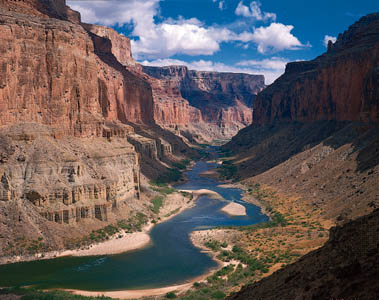
EXPLORATIONS IN GRAND CANYON

Mysteries of Immense Rich Cavern being brought to light Jordan is enthused remarkable finds indicate ancient people migrated from Orient.


The latest news of the progress of the explorations of what is now
regarded by scientists as not only the oldest archeological
discovery in the United States, but one of the most valuable in the
world, which was mentioned some time ago in the Gazette, was brought
to the city yesterday by G.E. Kinkaid, the explorer who found the
great underground citadel of the Grand Canyon during a trip from
Green River, Wyoming, down the Colorado, in a wooden boat, to Yuma,
several months ago.

According to the story related to the Gazette by Mr. Kinkaid, the
archaelogists of the Smithsonian Institute, which is financing the
expeditions, have made discoveries which almost conclusively prove
that the race which inhabited this mysterious cavern, hewn in solid
rock by human hands, was of oriental origin, possibly from Egypt,
tracing back to Ramses. If their theories are borne out by the
translation of the tablets engraved with heiroglyphics, the mystery
of the prehistoric peoples of North America, their ancient arts, who
they were and whence they came, will be solved. Egypt and the Nile,
and Arizona and the Colorado will be linked by a historical chain
running back to ages which staggers the wildest fancy of the
fictionist.

A Thorough Examination

Under the direction of Prof. S. A. Jordan, the Smithsonian Institute
is now prosecuting the most thorough explorations, which will be
continued until the last link in the chain is forged. Nearly a mile
underground, about 1480 feet below the surface, the long main
passage has been delved into, to find another mammoth chamber from
which radiates scores of passageways, like the spokes of a wheel.

Several hundred rooms have been discovered, reached by passageways
running from the main passage, one of them having been explored for
854 feet and another 634 feet. The recent finds include articles
which have never been known as native to this country, and doubtless
they had their origin in the orient. War weapons, copper
instruments, sharp-edged and hard as steel, indicate the high state
of civilization reached by these strange people. So interested have
the scientists become that preparations are being made to equip the
camp for extensive studies, and the force will be increased to
thirty or forty persons.

Mr. Kinkaid's Report

Mr. Kinkaid was the first white child born in Idaho and has been an
explorer and hunter all his life, thirty years having been in the
service of the Smithsonian Institute. Even briefly recounted, his
history sounds fabulous, almost grotesque.

"First, I would impress that the cavern is nearly inaccessible. The
entrance is 1,486 feet down the sheer canyon wall. It is located on
government land and no visitor will be allowed there under penalty
of trespass. The scientists wish to work unmolested, without fear
of archeological discoveries being disturbed by curio or relic
hunters.

A trip there would be fruitless, and the visitor would be sent on
his way. The story of how I found the cavern has been related, but
in a paragraph: I was journeying down the Colorado river in a boat,
alone, looking for mineral. Some forty-two miles up the river from
the El Tovar Crystal canyon, I saw on the east wall, stains in the
sedimentary formation about 2,000 feet above the river bed. There
was no trail to this point, but I finally reached it with great
difficulty.

Above a shelf which hid it from view from the river, was the mouth
of the cave. There are steps leading from this entrance some thirty
yards to what was, at the time the cavern was inhabited, the level
of the river. When I saw the chisel marks on the wall inside the
entrance, I became interested, securing my gun and went in. During
that trip I went back several hundred feet along the main passage
till I came to the crypt in which I discovered the mummies. One of
these I stood up and photographed by flashlight. I gathered a
number of relics, which I carried down the Colorado to Yuma, from
whence I shipped them to Washington with details of the discovery.
Following this, the explorations were undertaken.

The Passages

"The main passageway is about 12 feet wide, narrowing to nine feet
toward the farther end. About 57 feet from the entrance, the first
side-passages branch off to the right and left, along which, on both
sides, are a number of rooms about the size of ordinary living rooms
of today, though some are 30 by 40 feet square. These are entered
by oval-shaped doors and are ventilated by round air spaces through
the walls into the passages. The walls are about three feet six
inches in thickness.

The passages are chiseled or hewn as straight as could be laid out
by an engineer. The ceilings of many of the rooms converge to a
center. The side-passages near the entrance run at a sharp angle
from the main hall, but toward the rear they gradually reach a right
angle in direction.

The Shrine

"Over a hundred feet from the entrance is the cross-hall, several
hundred feet long, in which are found the idol, or image, of the
people's god, sitting cross-legged, with a lotus flower or lily in
each hand. The cast of the face is oriental, and the carving this
cavern. The idol almost resembles Buddha, though the scientists are
not certain as to what religious worship it represents. Taking into
consideration everything found thus far, it is possible that this
worship most resembles the ancient people of Tibet.

Surrounding this idol are smaller images, some very beautiful in
form; others crooked-necked and distorted shapes, symbolical,
probably, of good and evil. There are two large cactus with
protruding arms, one on each side of the dais on which the god
squats. All this is carved out of hard rock resembling marble. In
the opposite corner of this cross-hall were found tools of all
descriptions, made of copper. These people undoubtedly knew the
lost art of hardening this metal, which has been sought by chemicals
for centureis without result. On a bench running around the
workroom was some charcoal and other material probably used in the
process. There is also slag and stuff similar to matte, showing
that these ancients smelted ores, but so far no trace of where or
how this was done has been discovered, nor the origin of the ore.

"Among the other finds are vases or urns and cups of copper and
gold, made very artistic in design. The pottery work includes
enameled ware and glazed vessels. Another passageway leads to
granaries such as are found in the oriental temples. They contain
seeds of varous kinds. One very large storehouse has not yet been
entered, as it is twelve feet high and can be reached only from
above. Two copper hooks extend on the edge, which indicates that
some sort of ladder was attached. These granaries are rounded, as
the materials of which they are constructed, I think, is a ver hard
cement. A gray metal is also found in this cavern, which puzzles
the scientists, for its identity has not been established. It
resembles platinum. Strewn promiscuously over the floor everywhere
are what people call "cats eyse', a yellow stone of no great value.
Each one is engraved with the head of the Malay type.

The Hieroglyphics

"On all the urns, or walls over doorways , and tablets of stone
which were found by the image are the mysterious hieroglyphics, the
key to which the Smithsonian Institute hopes yet to discover. The
engraving on the tables probably has something to do with the
religion of the people. Similar hieroglyphics have been found in
southern Arizona. Among the pictorial writings, only two animals
are found. One is of prehistoric type.

The Crypt

"The tomb or crypt in which the mummies were found is one of the
largest of the chambers, the walls slanting back at an angle of
about 35 degrees. On these are tiers of mummies, each one occupying
a separate hewn shelf. At the head of each is a small bench, on
which is found copper cups and pieces of broken swords. Some of the
mummies are covered with clay, and all are wrapped in a bark fabric.

The urns or cups on the lower tiers are crude, while as the higher
shelves are reached, the urns are finer in design, showing a later
stage of civilization. It is worthy of note that all the mummies
examined so far have proved to be male, no children or females being
buried here. This leads to the belief that this exterior section
was the warriors' barracks.

"Among the discoveries no bones of animals have been found, no
skins, no clothing, no bedding. Many of the rooms are bare but for
water vessels. One room, about 40 by 700 feet, was probably the
main dining hall, for cooking utensils are found here. What these
people lived on is a problem, though it is presumed that they came
south in the winter and farmed in the valleys, going back north in
the summer.

Upwards of 50,000 people could have lived in the caverns
comfortably. One theory is that the present Indian tribes found in
Arizona are descendants of the serfs or slaves of the people which
inhabited the cave. Undoubtedly a good many thousands of years
before the Christian era, a people lived here which reached a high
stage of civilization. The chronology of human history is full of
gaps. Professor Jordan is much enthused over the discoveries and
believes that the find will prove of incalculable value in
archeological work.

"One thing I have not spoken of, may be of interest. There is one
chamber of the passageway to which is not ventilated, and when we
approached it a deadly, snaky smell struck us. Our light would not
penetrate the gloom, and until stronger ones are available we will
not know what the chamber contains. Some say snakes, but other
boo-hoo this idea and think it may contain a deadly gas or chemicals
used by the ancients. No sounds are heard, but it smells snaky just
the same. The whole underground installation gives one of shaky
nerves the creeps. The gloom is like a weight on one's shoulders,
and our flashlights and candles only make the darkness blacker.
Imagination can revel in conjectures and ungodly daydreams back
through the ages that have elapsed till the mind reels dizzily in
space."

An Indian Legend

In connection with this story, it is notable that among the Hopi
Indians the tradition is told that their ancestors once lived in an
underworld in the Grand Canyon till dissension arose between the
good and the bad, the people of one heart and the people of two
hearts. Machetto, who was their chief, counseled them to leave the
underworld, but there was no way out. The chief then caused a tree
to grow up and pierce the roof of the underworld, and then the
people of one heart climbed out. They tarried by Paisisvai (Red
River), which is the Colorado, and grew grain and corn.

They sent out a message to the Temple of the Sun, asking the
blessing of peace, good will and rain for people of one heart. That
messenger never returned, but today at the Hopi villages at sundown
can be seen the old men of the tribe out on the housetops gazing
toward the sun, looking for the messenger. When he returns, their
lands and ancient dwelling place will be restored to them. That is
the tradition.

Among the engravings of animals in the cave is seen the image of a
heart over the spot where it is located. The legend was learned by
W.E. Rollins, the artist, during a year spent with the Hopi Indians.

There are two theories of the origin of the Egyptians. One is that
they came from Asia; another that the racial cradle was in the upper
Nile region. Heeren, an Egyptologist, believed in the Indian origin
of the Egyptians. The discoveries in the Grand Canyon may throw
further light on human evolution and prehistoric ages.


If you like this post just click here Posted By crkota with No comments

Archeological Cover Ups?

by David Hatcher Childress

Most of us are familiar with the last scene in the popular Indiana
Jones archeological adventure film RAIDERS OF THE LOST ARK in which
an important historical artefact, the Ark of the Covenant from the
Temple in Jerusalem, is locked in a crate and put in a giant
warehouse, never to be seen again, thus ensuring that no history
books will have to be rewritten and no history professor will have
to revise the lecture that he has been giving for the last forty
years.

While the film was fiction, the scene in which an important ancient
relic is buried in a warehouse is uncomfortably close to reality for
many researchers. To those who investigate allegations of
archaeological cover-ups, there are disturbing indications that the
most important archaeological institute in the United States, the
Smithsonian Institute, an independent federal agency, has been
actively suppressing some of the most interesting and important
archaeological discoveries made in the Americas.

The Vatican has been long accused of keeping artefacts and ancient
books in their vast cellars, without allowing the outside world
access to them. These secret treasures, often of a controversial
historical or religious nature, are allegedly suppressed by the
Catholic Church because they might damage the church's credibility,
or perhaps cast their official texts in doubt. Sadly, there is
overwhelming evidence that something very similar is happening with
the Smithsonian Institution.

The cover-up and alleged suppression of archaeological evidence
began in late 1881 when John Wesley Powell, the geologist famous for
exploring the Grand Canyon, appointed Cyrus Thomas as the director
of the Eastern Mound Division of the Smithsonian Institution's
Bureau of Ethnology.

When Thomas came to the Bureau of Ethnology he was a

"pronounced believer in the existence of a race of Mound Builders,
distinct from the American Indians."

However, John Wesley Powell, the director of the Bureau of
Ethnology, a very sympathetic man toward the American Indians, had
lived with the peaceful Winnebago Indians of Wisconsin for many
years as a youth and felt that American Indians were unfairly
thought of as primitive and savage.

The Smithsonian began to promote the idea that Native Americans, at
that time being exterminated in the Indian Wars, were descended from
advanced civilisations and were worthy of respect and protection.

They also began a program of suppressing any archaeological evidence
that lent credence to the school of thought known as Diffusionism, a
school which believes that throughout history there has been
widespread dispersion of culture and civilisation via contact by
ship and major trade routes.

The Smithsonian opted for the opposite school, known as
Isolationism. Isolationism holds that most civilisations are
isolated from each other and that there has been very little contact
between them, especially those that are separated by bodies of
water. In this intellectual war that started in the 1880s, it was
held that even contact between the civilisations of the Ohio and
Mississippi Valleys were rare, and certainly these civilisations did
not have any contact with such advanced cultures as the Mayas,
Toltecs, or Aztecs in Mexico and Central America. By Old World
standards this is an extreme, and even ridiculous idea, considering
that the river system reached to the Gulf of Mexico and these
civilisations were as close as the opposite shore of the gulf. It
was like saying that cultures in the Black Sea area could not have
had contact with the Mediterranean.

When the contents of many ancient mounds and pyramids of the Midwest
were examined, it was shown that the history of the Mississippi
River Valleys was that of an ancient and sophisticated culture that
had been in contact with Europe and other areas. Not only that, the
contents of many mounds revealed burials of huge men, sometimes
seven or eight feet tall, in full armour with swords and sometimes
huge treasures.

(Vangard note..>Eastern Indian texts say that at one time men lived
thousands of years and grew very tall in direct proportion to their
age, as does the Bible with the comment "and there were GIANTS in
the earth in those days...")

For instance, when Spiro Mound in Oklahoma was excavated in the
1930's, a tall man in full armour was discovered along with a pot of
thousands of pearls and other artefacts, the largest such treasure
so far documented. The whereabouts of the man in armour is unknown
and it is quite likely that it eventually was taken to the
Smithsonian Institution.

In a private conversation with a well-known historical researcher
(who shall remain nameless), I was told that a former employee of
the Smithsonian, who was dismissed for defending the view of
diffusionism in the Americas (i.e. the heresy that other ancient
civilisations may have visited the shores of North and South America
during the many millenia before Columbus), alleged that the
Smithsonian at one time had actually taken a barge full of unusual
artefacts out into the Atlantic and dumped them in the ocean.

Though the idea of the Smithsonian' covering up a valuable
archaeological find is difficult to accept for some, there is,
sadly, a great deal of evidence to suggest that the Smithsonian
Institution has knowingly covered up and 'lost' important
archaeological relics. The STONEWATCH NEWSLETTER of the Gungywamp
Society in Connecticut, which researches megalithic sites in New
England, had a curious story in their Winter 1992 issue about stone
coffins discovered in 1892 in Alabama which were sent to the
Smithsonian Institution and then 'lost'. According to the
newsletter, researcher Frederick J. Pohl wrote an intriguing letter
in 1950 to the late Dr. T.C. Lethbridge, a British archaeologist.

The letter from Pohl stated, "A professor of geology sent me a
reprint (of the) Smithsonian Institution, THE CRUMF BURIAL CAVE by
Frank Burns, US Geological Survey, from the report of the US
National Museum for 1892, pp 451-454, 1984. In the Crumf Cave,
southern branch of the Warrior River, in Murphy's Valley, Blount
County, Alabama, accessible from Mobile Bay by river, were coffins
of wood hollowed out by fire, aided by stone or copper chisels.

Either of these coffins were taken to the Smithsonian. They were
about 7.5 feet long, 14" to 18" wide, 6" to 7" deep. Lids open.
"I wrote recently to the Smithsonian, and received a reply March
11th from F.M. Setzler, Head Curator of Department of Anthropology
(He said) 'We have not been able to find the specimens in our
collections, though records show that they were received."

David Barron, President of the Gungywamp Society was eventually told
by the Smithsonian in 1992 that the coffins were actually wooden
troughs and that they could not be viewed anyway because they were
housed in an asbestos-contaminated warehouse. This warehouse was to
be closed for the next ten years and no one was allowed in except
the Smithsonian personnel!

Ivan T. Sanderson, a well-known zoologist and frequent guest on
Johnny Carson's TONIGHT SHOW in the 1960s (usually with an exotic
animal with a pangolin or a lemur), once related a curious story
about a letter he received regarding an engineer who was stationed
on the Aleutian island of Shemya during World War II. While
building an airstrip, his crew bulldozed a group of hills and
discovered under several sedimentary layers what appeared to be
human remains. The Alaskan mound was in fact a graveyard of
gigantic human remains, consisting of crania and long leg bones.

The crania measured from 22 to 24 inches from base to crown. Since
an adult skull normally measures about eight inches from back to
front, such a large crania would imply an immense size for a
normally proportioned human. Furthermore, every skull was said to
have been neatly trepanned (a process of cutting a hole in the upper
portion of the skull).

In fact, the habit of flattening the skull of an infant and forcing
it to grow in an elongated shape was a practice used by ancient
Peruvians, the Mayas, and the Flathead Indians of Montana. Sanderson
tried to gather further proof, eventually receiving a letter from
another member of the unit who confirmed the report. The letters
both indicated that the Smithsonian Institution had collected the
remains, yet nothing else was heard. Sanderson seemed convinced
that the Smithsonian Institution had received the bizarre relics,
but wondered why they would not release the data. He asks, "...is
it that these people cannot face rewriting all the textbooks?"

In 1944 an accidental discovery of an even more controversial nature
was made by Waldemar Julsrud at Acambaro, Mexico. Acambaro is in
the state of Guanajuato, 175 miles northwest of Mexico City. The
strange archaeological site there yielded over 33,500 objects of
ceramic;stone, including jade; and knives of obsidian (sharper than
steel and still used today in heart surgery). Jalsrud, a prominent
local German merchant, also found statues ranging from less than an
inch to six feet in length depicting great reptiles, some of them in
ACTIVE ASSOCIATION with humans - generally eating them, but in some
bizarre statuettes an erotic association was indicated. To
observers many of these creatures resembled dinosaurs.

Jalsrud crammed this collection into twelve rooms of his expanded
house. There startling representations of Negroes, Orientals, and
bearded Caucasians were included as were motifs of Egyptians,
Sumerian and other ancient non-hemispheric civilisations, as well as
portrayals of Bigfoot and aquatic monsterlike creatures, weird
human-animal mixtures, and a host of other inexplicable creations.
Teeth from an extinct Ice Age horse, the skeleton of a mammoth, and
a number of human skulls were found at the same site as the ceramic
artefacts.

Radio-carbon dating in the laboratories of the University of
Pennsylvania and additional tests using the thermoluminescence
method of dating pottery were performed to determine the age of the
objects. Results indicated the objects were made about 6,500 years
ago, around 4,500 BC. A team of experts at another university,
shown Jalrud's half-dozen samples but unaware of their origin, ruled
out the possibility that they could have been modern reproductions.
However, they fell silent when told of their controversial source.

In 1952, in an effort to debunk this weird collection which was
gaining a certain amount of fame, American archaeologist Charles C.
DiPeso claimed to have minutely examined the then 32,000 pieces
within not more than four hours spent at the home of Julsrud. In a
forthcoming book, long delayed by continuing developments in his
investigation, archaeological investigator John H. Tierney, who has
lectured on the case for decades, points out that to have done that
DiPeso would have had to have inspected 133 pieces per minute
steadily for four hours, whereas in actuality, it would have
required weeks merely to have separated the massive jumble of
exhibits and arranged them properly for a valid evaluation.

Tierney, who collaborated with the later Professor Hapgood, the late
William N. Russell, and others in the investigation, charges that
the Smithsonian Institution and other archaeological authorities
conducted a campaign of disinformation against the discoveries. The
Smithsonian had, early in the controversy, dismissed the entire
Acambaro collection as an elaborate hoax. Also, utilising the
Freedom of Information Act, Tierney discovered that practically the
entirety of the Smithsonian's Julsrud case files are missing.

After two expeditions to the site in 1955 and 1968, Professor
Charles Hapgood, a professor of history and anthropology at the
University of New Hampshire, recorded the results of his 18-year
investigation of Acambaro in a privately printed book entitled
MYSTERY IN ACAMBARO. Hapgood was initially an open-minded skeptic
concerning the collection but became a believer after his first
visit in 1955, at which time he witnessed some of the figures being
excavated and even dictated to the diggers where he wanted them to
dig.

Adding to the mind-boggling aspects of this controversy is the fact
that the Instituto Nacional de Antropologia e Historia, through the
late Director of PreHispanic Monuments, Dr. Eduardo Noguera, (who,
as head of an official investigating team at the site, issued a
report which Tierney will be publishing), admitted "the apparent
scientific legality with which these objects wer found." Despite
evidence of their own eyes, however, officials declared that because
of the objects 'fantastic' nature, they had to have been a hoax
played on Julsrud!

A disappointed but ever-hopeful Julsrud died. His house was sold
and the collection put in storage. The collection is not currently
open to the public.

Perhaps the most amazing suppression of all is the excavation of an
Egyptian tomb by the Smithsonian itself in Arizona. A lengthy front
page story of the PHOENIX GAZETTE on 5 April 1909 (follows this
article), gave a highly detailed report of the discovery and
excavation of a rock-cut vault by an expedition led by a Professor
S.A. Jordan of the Smithsonian. The Smithsonian, however, claims to
have absolutely no knowledge of the discovery or its discoverers.

The World Explorers Club decided to check on this story by calling
the Smithsonian in Washington, D.C., though we felt there was little
chance of getting any real information. After speaking briefly to
an operator, we were transferred to a Smithsonian staff
archaeologist, and a woman's voice came on the phone and identified
herself.

I told her that I was investigating a story from a 1909 Phoenix
newspaper article about the Smithsonian Institution's having
excavated rock-cut vaults in the Grand Canyon where Egyptian
artefacts had been discovered, and whether the Smithsonian
Institution could give me any more information on the subject.

"Well, the first thing I can tell you, before we go any further,"
she said, "is that no Egyptian artefacts of any kind have ever been
found in North or South America. Therefore, I can tell you that the
Smithsonian Institute has never been involved in any such
excavations." She was quite helpful and polite but, in the end,
knew nothing. Neither she nor anyone else with whom I spoke could
find any record of the discovery or either G.E. Kinkaid and
Professor S.A. Jordan.

While it cannot be discounted that the entire story is an elaborate
newspaper hoax, the fact that it was on the front page, named the
prestigious Smithsonian Institution, and gave a highly detailed
story that went on for several pages, lends a great deal to its
credibility. It is hard to believe such a story could have come out
of thin air.

Is the Smithsonian Institution covering up an archaeological
discovery of immense importance? If this story is true it would
radically change the current view that there was no transoceanic
contact in pre-Columbian times, and that all American Indians, on
both continents, are descended from Ice Age explorers who came
across the Bering Strait. (Any information on G.E. Kinkaid and
Professor S.A. Jordan, or their alleged discoveries, that readers
may have would be greatly appreciated.....write to Childress at the
World Explorers Club at the above address.)

Is the idea that ancient Egyptians came to the Arizona area in the
ancient past so objectionable and preposterous that it must be
covered up? Perhaps the Smithsonian Institution is more interested
in maintaining the status quo than rocking the boat with astonishing
new discoveries that overturn previously accepted academic
teachings.

Historian and linguist Carl Hart, editor of WORLD EXPLORER, then
obtained a hiker's map of the Grand Canyon from a bookstore in
Chicago. Poring over the map, we were amazed to see that much of
the area on the north side of the canyon has Egyptian names. The
area around Ninety-four Mile Creek and Trinity Creek had areas (rock
formations, apparently) with names like Tower of Set, Tower of Ra,
Horus Temple, Osiris Temple, and Isis Temple. In the Haunted Canyon
area were such names as the Cheops Pyramid, the Buddha Cloister,
Buddha Temple, Manu Temple and Shiva Temple. Was there any
relationship between these places and the alleged Egyptian
discoveries in the Grand Canyon?

We called a state archaeologist at the Grand Canyon, and were told
that the early explorers had just liked Egyptian and Hindu names,
but that it was true that this area was off limits to hikers or
other visitors, "because of dangerous caves."

Indeed, this entire area with the Egyptian and Hindu place names in
the Grand Canyon is a forbidden zone - no one is allowed into this
large area.

We could only conclude that this was the area where the vaults were
located. Yet today, this area is curiously off-limits to all hikers
and even, in large part, park personnel.

I believe that the discerning reader will see that if only a small
part of the "Smithsoniangate" evidence is true, then our most
hallowed archaeological institution has been actively involved in
suppressing evidence for advanced American cultures, evidence for
ancient voyages of various cultures to North America, evidence for
anomalistic giants and other oddball artefacts, and evidence that
tends to disprove the official dogma that is now the history of
North America.

The Smithsonian's Board of Regents still refuses to open its
meetings to the news media or the public. If Americans were ever
allowed inside the 'nation's attic', as the Smithsonian has been
called, what skeletons might they find?

If you like this post just click here Posted By crkota with 2 comments

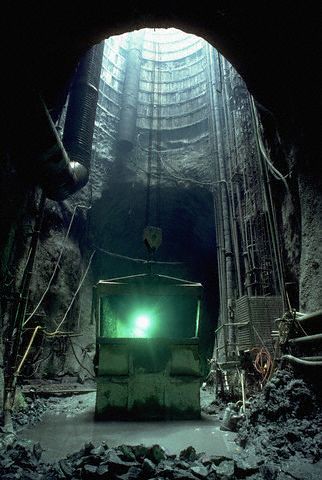
Underground Entrances

The Liyobaa Cave Entrances

After the conquest of South America by the Spanish Conquistadores, the Catholic priests who were attempting to convert the heathen Indians discovered a cave entrance to what they called "Hell." This entrance has since been sealed off with tons of rubble, dirt and huge stones and boulders.

The village of Liyobaa (or to translate it, "The Cavern of Death") was located in the province of Zapoteca, somewhere near the ancient village of Mictlan, or the "Village of the Underworld."

The Cavern of Death was actually located in the last chamber of an eight-chamber building or temple. This temple had four rooms above the ground and four more important chambers built below the surface.

The high priests of the then-prevailing Indian religion conducted the ordinary ceremonies for the common man of Theozapotlan in the upper rooms. It was when they descended into the subsurface chambers that the secret and, to them, holy ceremonies, were conducted.

The first underground room was the one which was reserved for any human sacrifice. Its walls were lined with the images of the representations of their various "Gods." A blood-stained stone altar in the center of the chamber served for the sacrifice of any human victim, whose still-beating heart would be torn from a screaming still-living body and offered to the lips of those same stone idols for their supposed repletion.

There was a second door in the first chamber which led to the second room. This was a crypt where the preserved bodies of all the deceased high priests reposed. The next door in this crypt led to the third underground vault, about the walls of which were the preserved bodies of all the former "Kings" of Theozapotlan. For, on the death of a king, his body was brought to this chamber and installed there with all the state and glory, as well as with many sacrifices to accompany him.

It was from this burial chamber of kings that the fourth and last underground room was accessible. A doorway in third room led into the last underground chamber which seems appropriately to have contained nothing but another entrance covered by a huge stone slab. I write "appropriately," for the entrance to either HELL or the CAVES should be covered but unencumbered in the area about it for the benefit of those who might wish to leave rapidly and wisely. It was conceived by the Catholic Fathers of that day that this was an entrance to Hades; however, as we may well understand, it was an entrance to a Dero larder.

Through this doorway behind the stone slab were placed the bodies of all human sacrifices as well as the bodies of all the great lords and chieftains of the land who fell in battle. The bodies of those warriors were brought from far and wide to be thrown into this cave when they had been cut down in battles which were constantly being waged by these people.

Many of the common people, when debilitated by an incurable illness or oppressed by an unsupportable hardship, which made them seek death, would prevail upon the high priests to allow them to enter the door of death while still living. They believed that if they did so they would be the recipients of a very special afterlife.

The high priests would sometimes accept them as living sacrifices and after special ceremonies allow them to enter the "Cavern of Death" while still living. Needless to say, none ever returned to describe their experiences.

The Catholic priests, in order to convert the believers in this "myth" to Christianity, made arrangements to enter this subterranean door with a large retinue of torch holders and a long rope, which was tied to the stone slab door. They also took the precaution of having a large armed guard make sure that the door was not closed on them.

After they had lighted their torches and entered the door, it was discovered that they would have to descend several large steps. At the foot of the steps was a very wide stone-paved passageway with a high stone buttress on either side. The passageway led directly away from the steps into the distant bowels of the earth. The bones of the most recent arrivals, picked clean, lay before them as the passage seemed to continue without end. On each side of the buttressed path they could see into a large area which was a large labyrinth of stone pillars that seemed to hold up the very mountains which they knew they were beneath. As they advanced into the mountain, a putrid, dank air assailed their nostrils, serpents retreated from the light behind the shadows of the pillars in the distance.

They continued into the depths at a distance of about 40 meters when suddenly a strong cold wind began to blow about them. Still striving to continue, as their torches were extinguished rapidly, they took flight when all became dark, not only for the danger of the serpents, but also from strange sounds they could not place, but which were not being made by the members of their own party. Using the rope and the light of the torch one of the guards held in the doorway, out of the strong wind, the entire party rapidly retreated from this terrifying region.

When all the company had swiftly retreated to the ante-chamber of "Hell," they rapidly replaced the large stone slab door. After this the head prelate gave orders to fill in all the underground chambers and seal off and erase all signs of the stairs to them, thus eradicating for all time this entrance to the Caves.


The Tunnels of South America

In Southern and Central America, as well as in Mexico, the ancient people did not deny the existence of subterranean caves, chambers or tunnels. An examination of the religious beliefs of these ancient civilizations will reveal this.

The Aztecs of Mexico had their dark, dreary and much-feared "Tlaxico" which was ruled by "Mictlan," their god of death. The Mayas of Yucatan held a belief in the existence of underworlds. These they termed "Mitlan," and they were icy cold as are most subterranean chambers or tunnels (for proof visit a large cavern in summer clothes and see how uncomfortable you are). These underworlds were presided over by "Ah Puch." the Lord of Death. We also have mention of the underground in the Mayan sacred writings, the "Popol Vuh"; as well as in the "Book of Chilam of Chumayel." Even some of the codices seem to refer to them.

Peru and Chile, when they were ruled by the Incas, also reveal knowledge of the underground. "Supai," the god of death, had an underground dwelling, a much feared "Place of Darkness ." "Pachacamce," the god of the earth, caused underground rumblings in subterranean places where huge stones evidently fell, hours after he had shaken the earth with violence.

A legend of the first Inca "Manco Capac" relates that he and his followers, the founders of the Inca real, came from underground caves, while the people of the time revered snakes because of "Urcaguay," the god of the underground treasures. This god is depicted as a large snake whose tail has a hanging pendant from it, the head of a deer and many little gold chains. Even the "Comentarios Reales de los Incas" of Garciliasso de la Vega hints at the existence of the subterranean.

References to the tunnels have come down to us from information that the Conquistadores obtained. From some unknown source they had gathered information that the wealth of the Inca's domain was stored in a vast underground tunnel or road, and Pizzaro held the Inca Atahuelpha prisoner in order to obtain his wealth, which, it was rumored, was stored in a vast subterranean tunnel that ran for many miles below the surface of the earth. The Inca, if he had the information regarding the entrance to this tunnel, never revealed it. The priests of the Sun God and the Inca's wife determined, it is asserted, the eventual fate of the Inca by occult means. The knowledge that Pizzaro did not intend to spare the Inca Atahuelpha's life caused them to seal up the entrance and hide it so well that it has never been found to this day.

A few Quincha Indians, who are pure descendants of the line of priests, are said to still have the knowledge of the location of the entrance to this tunnel. They are the appointed guardians of this escort, so it is rumored today in Peru.

Another source of tunnel information may be a huge monolith of perpendicular rock, which stands apart from its native habitat, the mountains. This rock is of lava, and how it was erected or who erected it is lost in the ages of antiquity, long before the Incas came on the scene. The huge monolith stands alone on the shore of Ila, a small town in the southern tip of Peru, not far from the Chilean border. The rock bears odd hieroglyphic marks carved upon it. Marks which only in the light of the setting sun create a cryptic group of symbols. It is said that these marks will reveal to the person able to read them and decipher the message correctly the location of a secret entrance to the tunnels,an entrance located, some researchers assert, in the fastness of the "Los Tres Picas," the Three Peaks region. This is a triangular formation of mountain tops near the monolith in the Loa River section.

When Mme. Blavatsky visited Peru, she viewed and concurred with the information regarding the markings on the Ila monolith. She also asserted that information regarding the entrances to the tunnels had been graven in the walls of the "Sun Temple," at Cusco. Information of a symbolized nature, but nevertheless information which revealed to the person, with the knowledge of the meaning of the symbols, the secret entrance to those tunnels which the priests of the "Sun God" knew about. It is reported that Mme. Blavatsky received a chart of the tunnels, from an old Indian, when she visited Lima. This chart now reposes in the Adyar, India, archives of the Theosophical Society.

Harold T. Wilkins, author of Mysteries of Ancient South America, also researched and inquired about the tunnels until he was able to conclude the following: Two underground roads leave the vicinity of Lima, Peru. One of these tunnels is a subterranean road to Cusco, almost 400 miles to the east. The other runs underground in a southern direction for more than 900 miles to the vicinity of Salar de Atacama. This is a large salt desert in Chile, the residue of the ocean water which was landlocked during an upheaval of the earth. The upheaval of cataclysm which created Lake Titicaca raised Huanuco high above its place on the shore line. For information about this event, see the section titled "Tiahuanacu in the Andes" of Imanuel Velikovsky's Earth in Upheaval.

The Cordellarias domeyko, in that section of Chile, very evidently landlocked a great portion of the sea when it was raised. After the sea water evaporated, the vast salt waste, which is almost impossible to traverse, was left.

The tunnel, which has a entrance somewhere in the Los Tres Picos triangle, is also said to have a connection with this long southern underground road.

I conjecture that any continuation of the southern tunnel was broken during the cataclysm, which created the Andes mountain range. Such a continuation would have connected these ancient tunnels with the reputed Rainbow City center in the Antarctic.

I also conjecture that another event may have also happened during a shifting of the earth's crust at that time. Some of my readers may be familiar with the fact that at least one tribe of Indians in the Southwestern United States has a legend of coming from South America.

This legend relates a story of many years ago. The forefathers of the tribe are said to have lived in a large city far to the south. The story even ties the stars of the sky with the Southern Cross. The town may have been Huanuaca before the earth shift which raised it above sea level. At any rate the legend asserts that the people of this town in the south, the forefathers of a tribe of American Indians, were driven from their homes by a much more hostile and fierce group of warriors. The remnants of those who fled wandered for a long, long time in underground passages which led to the north. These passages eventually led them to our Southwest, where they emerged and set up tribal life once again.

How these ancient Indians were able to see in the dark does not seem to have been taken into consideration. The question of how these ancient tunnels of the Atlan or Titan were illuminated has long been of interest to those who follow the Shaver Mystery. It has long been considered that the tunnels were lit by a type of atomic light.

Steve Brodie is once again a captive of the subterranean people, if he is still alive! I cannot ask him about this, and I regret that it did not come to mind during the all-to-brief period that I knew him many years ago. I do know, however, that he never mentioned any darkness except in relation to the weird outer space pictures he painted. Light is a funny thing: we accept it as our due and never notice it until it is missing. Perhaps some time in the future we may find one of the entrances to the caves and discover just how they are lighted.


The Maltese Cave Entrance

The Maltese Cave entrance is on the island of Malta. This island is the largest of a group of three islands, in the sea that divides Europe from Africa, the Mediterranean. The little Maltese islands lay well off the coast of a much larger island, Sicily, halfway between the Libyan seaport of Tripoli and Calabria of Italy's Calabrese people who are located in the toe of the bootlike formation of Italy.

The three Maltese islands are composed of Gozo, Comino and Malta. They represent one of the smallest archipelagoes in the world, survivors of those remote days when continents were of a different shape. Those pre-cataclysm days when Atlantis and Mu may have existed, the days when there was a land bridge between Europe and Africa. Those days when the entire Mediterranean area was merely a series of large lakes.

Malta is the principle island of the three. It reaches a width of almost nine miles, while it is all of 17½ miles in length. Gozo is not as long as Malta is wide and Comino is almost a dot which separates them. Comino has at times boasted of a total population of 50 people.

Malta is the most southern island, 180 miles from the African coast. It was an ancient center of civilization at the time when the Phoenicians from Carthage invaded and began to rule it. At that time blood sacrifice was not new to the Maltese and they readily accepted the priests of Moloch as another name for "Baal," the Sun or Fire God. These priests offered up human sacrifice to their god, one who rejoiced in the sacrifice of human victims and the outcries of the victims' parents.

Since the time of the Carthaginians, Malta has had many rulers: Romans, Arabs, Normans, Aragonese, Castilians. Then France ruled the island for a short time before it became the British possession it now is.

However, with all this varied history, and regardless of the many nations who ruled them, the people of those islands still speak the ancient Canaanite, Semitic tongue, the speech of the Phoenicians, and the mother tongue of Queen Dido, who was the founder of Carthage. Malta was the birthplace of Carthage's most famous citizen, the man who made Rome tremble at the height of his power: Hannibal— of the world's greatest generals.

On the northeast shore of Malta there are a number of large bays. One of these is known as Grand Harbor. This bay has a point of land extending into it upon which the capital of the Maltese Islands, the city of Valletta, is built. A few miles inland from this town toward the south, overlooking the plain which leads to the shore, is a large plateau known as the Corradino. The little village of Casal Paula is built on this plateau, and from the village one can view Valletta, Grand Harbour, the plain leading to it, and also look out to the sea.

In this small village of Casal Paula during the year 1902 workmen, who were digging a well, literally fell into the earth. They had once again uncovered the outer room of the Maltese Cave entrance. Since the well was to be dug for a house which was on the main street named "Hal Saflieni," and because this first cave was later discovered to be complex of caves, three of which were a series of chambers excavated out of solid rock on three even lower levels for each chamber, this entrance is known as the "Hypogeum of Hal Saflienti." A hypogeum is the Latin name for an underground structure.

Later this series of underground rooms was discovered to have been located in the middle of an ancient neolithic village. From the construction of the entrance stones, it is now assumed that at certain times a human sacrifice was chained before the entrance. The entrance and the walls and ceilings of some of the passageways and rooms have been found to be decorated with red ochre primitive art designs, but when first discovered the three caves were crammed with as many as 30,000 skeletons of men, woman, and children. After all these bones were cleared out, the primitive murals were discovered. They took the forms of diamond shapes, as well as oblated and elongated ovals, all of which were joined together with wavy lines and whirls. These decorations had been created solely from the application of red ochre, by the most primitive of methods.

Once past the entrance, a narrow passageway leads down into the first room. It is in this room, that the "Oracle" may be found. The Oracle is a hemispherical hole in the wall, a which is lower than the mouth of an ordinary-sized man. It is about two feet in diameter, and one can speak into it. A curved projection carved out of the back of the cave then acts as a sounding board. The voice is amplified and caused to resound throughout all the other caves. It creates an effect which must have frightened the primitives into sacrificing many of the members of their tribe to the being who spoke with the "Voice of God."

If you continue down through the narrow and low passageways, you come to another room. The center of this room has a circular stone altar with runnels on it, the use of which can only be guessed at. Carved in the walls of this room are many niches, the bases of which are like bunk beds. They have hollows scooped out for the heads and bodies, as well as the feet of four-foot-high individuals and some are even smaller.

Leading downward from this room is a small, narrow passageway, ending in another even larger underground room, which has narrow slit-like entrances into other small caves which surround it. One opening, however, is a window into another cave, the entrance to which is covered by a huge slab of stone. This window looks down into what was evidently a prison, but how beings only four feet tall were able to manipulate the huge stone slab must remain a mystery.

An opening in the wall opposite the entrance to this cave leads to a passage narrow and torturous, the entrance to the real caves. This passage ends on a pathway which extends along the side of a vast cleft in the earth, a pathway along the edge of a veritable chasm, a pathway which leads ever downward to the long underground tunnels and series of caves which are reputed to allow one to traverse the entire length of the island and even further.

Legend has it that these passageways at one time connected with the underground crypts from which the Catacombs of Rome were created. This may very well be true; for the reader must remember that the Mediterranean Sea was created after neolithic times by earthquakes and the shifting of the earth's crust. Therefore, while the ancient tunnels may have existed, they might have been closed by cataclysms of this type, with the knowledge of them coming down to us only in legends.

The tunnels under the "Hypogeum" have been sealed off ever since a school teacher took 30 students into the caves and disappeared, guide and all. It was stated that the walls caved in on them. Search parties were never able to locate any trace of these people.

It has been asserted that for weeks the wailing and screaming of children was heard underground in different parts of the island, but no one could locate the source of the sound. If the walls caved in, why the cave-in could not be found and excavated to free the children remains a mystery.

How the children could live to scream for weeks later is another involved puzzle. At any rate, the underground entrance to the caves in Malta has been sealed off, and nobody is allowed to investigate the site.


If you like this post just click here Posted By crkota with No comments

The Philippines' Volcano show his power

MANILA, Philippines – The Philippines' most active volcano oozed lava and shot up plumes of ash Tuesday, forcing thousands of people to evacuate their homes and face the possibility of a bleak Christmas in a shelter.

State volcanologists raised the alert level on the cone-shaped, 8,070-foot (2,460-meter) Mayon volcano overnight to two steps below a major eruption after ash explosions.

Dark orange lava fragments glowed in the dark as they trickled down the mountain slope overnight. Renato Solidum, head of the Philippine Institute of Volcanology and Seismology, said the activity could get worse in coming days.

"It's already erupting," Solidum told The Associated Press.

More than 20,000 people were evacuated to safety by nightfall Tuesday, said Gov. Joey Salceda of Albay province, where Mayon is located about 210 miles (340 kilometers) southeast of Manila.

The first of 20 vehicles, including army trucks, were sent to villages to take residents to schools and other temporary housing, provincial emergency management official Jukes Nunez said.

"It's 10 days before Christmas. Most likely people will be in evacuation centers, and if Mayon's activity won't ease down we will not allow them to return to their homes," Nunez said. "It's difficult and sad, especially for children."

Residents in Albay are used to moving away from Mayon. Nearly 50,000 people live in a five-mile (eight-kilometer) radius around the mountain, and some villages were evacuated last month when the volcano spewed ash.

Mayon last erupted in 2006, and about 30,000 people were moved. Another eruption in 1993 killed 79 people.

Salceda said Tuesday that he has placed the central province under a "state of imminent disaster," which will make it easier for him to draw and use emergency funds.

Although the alarm has been sounded, life continued normally in many laid-back farming villages near the restive volcano. Throngs of farmers flocked to the town hall in Guinobatan, which lies near the danger zone, for a Christmas party, then headed home bearing gifts.

Village leader Romeo Opiana said the 249 residents in his farming community of Maninila, near the volcano, readied packs of clothes but no one had left. An army truck was parked nearby, ready to haul people if the threat grows.

"We're ready, but we're not really alarmed," said Opiana, 66. He could not remember how many times he had seen Mayon's eruptions since childhood.

Provincial governor Salceda said he had decided to cancel a trip to Copenhagen, where he was to attend the U.N. climate conference to discuss his province's experience with typhoons and other natural disasters.

He said he would appeal for foreign aid to deal with the expected influx of displaced villagers to emergency shelters.

"Whatever the volcano does, our target is zero casualty," Salceda told The Associated Press.

Magma had been rising at the volcano over the past two weeks and began to flow out of its crater Monday night, Solidum said. He said the volcano had so far only gently coughed out red-hot lava, which had flowed half a mile (half a kilometer) down from the crater.

Some classes were suspended indefinitely near the danger zone. Officials will find a way to squeeze in classes in school buildings to be used as shelters, Salceda said.

Mayon's most violent eruption, in 1814, killed more than 1,200 people and buried a town in mud.

The Philippines lies along the Pacific "Ring of Fire," where volcanic activity and earthquakes are common. About 22 out of 37 volcanos in the archipelago are active.

If you like this post just click here Posted By crkota with No comments

Golden Globe nominations 2010

The Golden Globe Award nominations announced Tuesday morning were dominated by the story of a man living his life in perpetual limbo.

"Up in the Air" -- the critically lauded drama that stars George Clooney as a professional downsizer who never misses an airline connection but fails to connect with his family -- led the field with six nominations, including nods for best motion picture -- drama; best director (Jason Reitman), best screenplay; best actor (Clooney) and best supporting players (Vera Farmiga and Anna Kendrick). Up against "Up in the Air" in that best picture category: "Avatar," James Cameron’s sci-fi epic that reportedly wowed members of the Foreign Press Association during screenings last week; "The Hurt Locker," Kathryn Bigelow’s intense and in-the-moment Iraq War picture; a war epic of a very different sort, Quentin Tarantino’s "Inglourious Basterds"; and "Precious," the adaptation of Sapphire’s novel "Push," about a pregnant teenager suffering from unspeakable abuse.

The Hollywood Foreign Press Association -- the group of international journalists behind the Globes, which revealed its field of contenders during an early morning news conference at the Beverly Hilton in Beverly Hills, Calif. -- routinely breaks its best-picture field into two categories, honoring five musicals or comedies in addition to the dramas.

The nominees on that funnier, more melodic end of the spectrum are: "Nine," the splashy adaptation of the Fellini-inspired Broadway show; "It’s Complicated," the rom-com for the 50-plus set starring Meryl Streep; "Julie & Julia," another Streep comedy, the one in which she cooks and clucks happily as Julia Child; "(500) Days of Summer," the boy-meets-then-loses-girl indie romance; and "The Hangover," the biggest box office hit (at least so far) among the top film contenders and proof that movies in which Mike Tyson air-drums to Phil Collins songs can, indeed, win some awards-season attention.

If "The Hangover" stood out as one of the Globes’ surprises in the film categories, it was hardly the only one. Among the other "Really?" moments:

-- Tobey Maguire’s nod for best actor in a drama for "Brothers," a film in limited release that never built much buzz in the all-important trophy-prediction blogosphere;

-- a nod for Julia Roberts as best actress in a musical-comedy for the almost-forgotten "Duplicity";

-- and not one, but two, nominations for Sandra Bullock, first for her turn as a no-nonsense businesswoman in "The Proposal" (musical/comedy), and second for her portrayal of a no-nonsense Tennessee woman who takes in a homeless high schooler in "The Blind Side" (drama).

Two other actors -- Matt Damon and Streep -- also walked away with dual nominations, the former for his dramatic work in "Invictus" and his comedic turn as clueless corporate spy in "The Informant!" and the latter for her roles in "It’s Complicated" and "Julie & Julia." (For those keeping score at home, that marks 25 lifetime Golden Globe nods for Streep. But at this point, really, who’s counting?)

The breakdown in another key category, best director, looks almost identical to the best motion picture category. Drama line-up: Reitman for "Up in the Air," Bigelow for "The Hurt Locker," Tarantino for "Inglourious Basterds," Cameron for "Avatar," plus one veteran whose film didn’t make the best picture cut, Clint Eastwood for his rugby uplifter "Invictus." (Which director in the best drama category was left without his own nomination? That would be Lee Daniels for "Precious.")

The Golden Globes have become newsworthy primarily because they serve as the ceremonial kickoff to the annual cinematic guessing game known as Oscar season. But let’s not forget that the Foreign Press also recognizes achievement in television, an area that was marked by far fewer surprises this year.

In the best drama category, "Mad Men," which has won the honor for the past two years, was again recognized, along with HBO’s "Big Love," "Dexter," "House" and "True Blood." The best comedy category also delivered three of the usual, albeit hilarious suspects -- "The Office," "30 Rock," "Entourage" -- but added a pair of newcomers to the mix: ABC’s "Modern Family" and -- get ready to burst into a round of "Don’t Stop Believin’," kids -- Fox’s popular "Glee."

As is always the case when nominations are announced, some notable names were left off the list. Peter Jackson’s once-buzzy "The Lovely Bones" scored only a single nod, for Stanley Tucci’s supporting performance. Same deal for the acclaimed "An Education," which was given recognition solely for its breakout star, Carey Mulligan. She received a nomination -- along with Bullock, Emily Blunt ("The Young Victoria"), Helen Mirren ("The Last Station") and newcomer Gabourey Sidibe ("Precious") -- in the best actress in a drama category.

The best actor in a drama contenders included Maguire, Clooney, Colin Firth ("A Single Man"), Morgan Freeman ("Invictus") and the Dude himself, Jeff Bridges, whose work as a grizzled country singer in "Crazy Heart" was already being touted as the performance to beat even before the Globes announcement.

So what does this all mean? Do the people basking in the glow of Foreign Press adulation this morning have a lock on an Oscar nod come Feb. 2? Not necessarily. Although the Globes often serve as foreshadowing for the Academy Awards, it’s worth noting that only once in the last five years -- last year, when "Slumdog Millionaire" fever swept the continents -- has a Globes’ best picture winner synched up with the Oscar’s top prize winner.

In other words, tune in to NBC when Ricky Gervais hosts the Globes on Jan. 17. But also keep an open mind.

If you like this post just click here Posted By crkota with No comments

Dubai, Abu Dhabi

Fears that Dubai might default on billions of dollars in debt eased Monday when its fellow United Arab Emirate, Abu Dhabi, pledged $10 billion in financing. (Abu Dhabi gives Dubai $10 billion bailout)

The announcement allays concerns raised last month when Dubai sought a six-month delay in debt payments for Dubai World, the government's flagship holding company. Global markets, which fell sharply when the Dubai debt problems were first raised, were mostly higher in Monday trading.

If you like this post just click here Posted By crkota with No comments

Exxon Mobil to Buy XTO Energy for $31 Billion

Exxon Mobil said Monday that it has agreed to buy XTO Energy, a natural gas producer, for $31 billion in stock and the assumption of $10 billion in debt, the largest energy merger in years.

Under the terms of the deal, Exxon will pay XTO shareholders .7098 common shares for each of their XTO shares, or about $51.69 based on Friday’s closing prices. The deal, which is taking advantage of low natural gas prices, represents a 25 percent premium for XTO’s shares.

The deal would give Exxon the equivalent of about 45 trillion cubic feet of natural gas throughout the United States, in a bet that demand will continue to rise. XTO, founded in 1986, is the nation’s largest domestic producer of natural gas.

“XTO is a leading U.S. unconventional natural gas producer, with an outstanding resource base, strong technical expertise and highly skilled employees,” Rex Tillerson, Exxon’s chief executive, said in a statement.

Exxon’s deal has prompted speculation among analysts over which natural gas producers may be up for sale next, with companies like Devon Energy now considered potential takeover targets.

Exxon said that after the deal’s close, expected in the second quarter next year, it would keep XTO as an upstream business unit to develop natural gas resources from unconventional sources like shale rock. The business will remain in XTO’s headquarters in Fort Worth, Tex.

Exxon was advised by JPMorgan Chase, while XTO was advised by Barclays Capital and Jefferies.

If you like this post just click here Posted By crkota with No comments

Attack on Italy Prime Minister Silvio Berlusconi

Italy's interior minister said on Monday yesterday's attack on Prime Minister Silvio Berlusconi could have been fatal and pledged measures to improve his security.

Berlusconi, 73, is still in hospital with broken nose, two teeth and injured upper lip after a man hurled a souvenir statuette at the premier while he was greeting the crowd and signing autographs after a flamboyant speech in Milan.

Speaking at a security conference in Milan, Roberto Maroni said: "Silvio Berlusconi could have been seriously injured or even killed yesterday."

Berlusconi told the Ansa news agency that he was "fine" and that it was a "miracle" he had not been struck in the eye.

Maroni pledged measures to improve the prime minister's security.

The minister also reiterated that the attack was a result of the atmosphere of "political intolerance" prevailing in the country.

The attacker, Massimo Tartaglia, 42, who was later reported to have a long record of mental illness, was jailed in the San Vittore prison last night. During preliminary questioning, he said he strongly opposed Berlusconi and the policies of the Italian government.

The premier has come under increasing pressure in recent weeks. Last Thursday, a mafia boss said during court hearings that Berlusconi and his old-time friend, senator Marcello Dell'Utri, had ties with the mafia. A day later a rally gathered in Rome to demand Berlusconi's resignation.

If you like this post just click here Posted By crkota with No comments

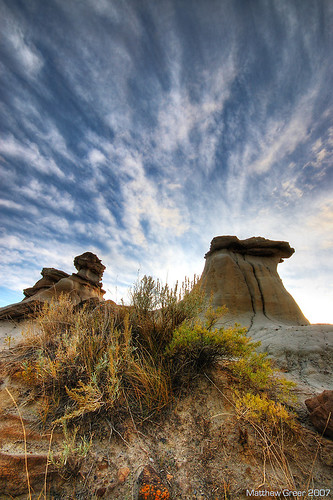
Dinosaur Provincial Park


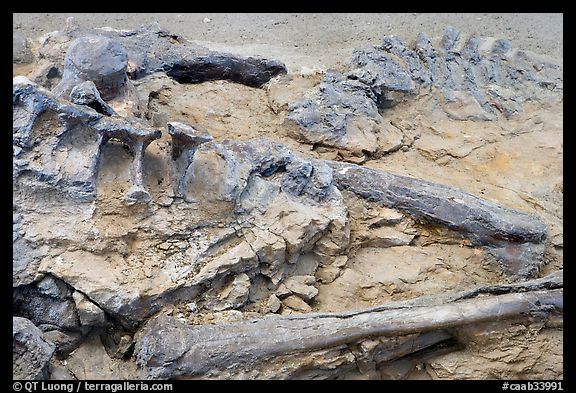
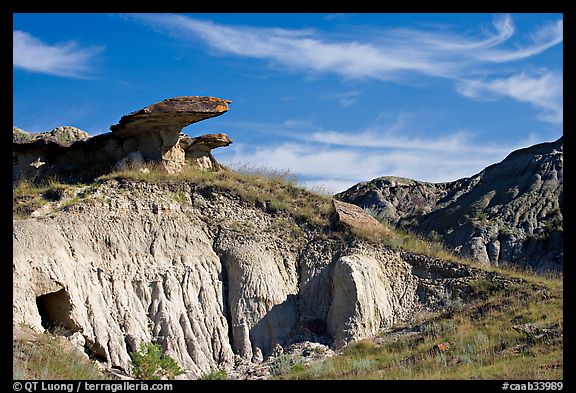
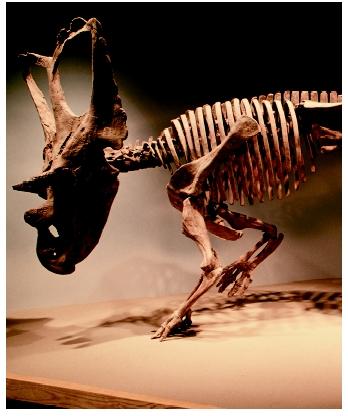
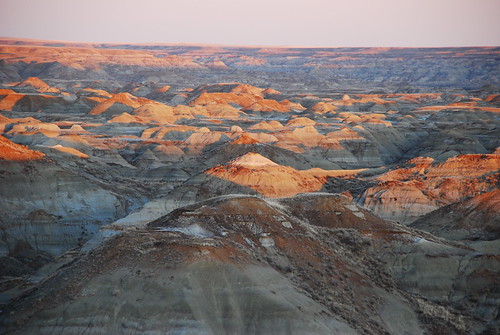
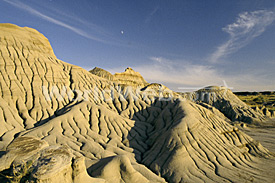
Badlands stretch along many river valleys throughout the North American plains, and some of the most spectacular sights are in 7,330-hectare (18,000-acre) Dinosaur Provincial Park, 200 kilometers (124 miles) east of Calgary. But the park is best known for being one of the most important dinosaur fossil beds in the world. Thirty-five species of dinosaurs--from every known family of the Cretaceous period--have been unearthed here, along with the skeletal remains of crocodiles, turtles, fish, lizards, frogs, and flying reptiles. Not only is the diversity of specimens great, but so is the sheer volume; more than 300 museum-quality specimens have been removed and are exhibited in museums around the world.

Originally established in 1955 to protect the fossil bonebeds, the park's environment is extremely complex and is unique within the surrounding prairie ecosystem. Stands of cottonwoods, a variety of animal life, and, most important, the extensive bonebeds, were instrumental in UNESCO's designation of the park as a World Heritage Site in 1979. In 1985, the opening of the Royal Tyrrell Museum of Palaeontology, 100 kilometers (62 miles) upstream in Drumheller, meant that bones that had previously been shipped to museums throughout the world for scientific analysis and display could now remain within the province. The Royal Tyrrell Museum operates a field station in the park, where many of the bones are cataloged and stored. The displays, films, and interpretive programs offered at the center will best prepare you to begin your visit to the park.


PREHISTORY

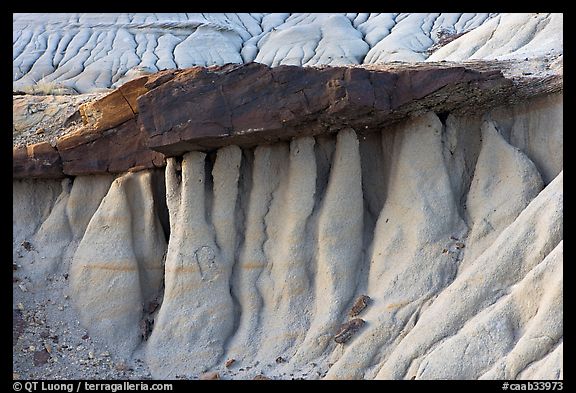
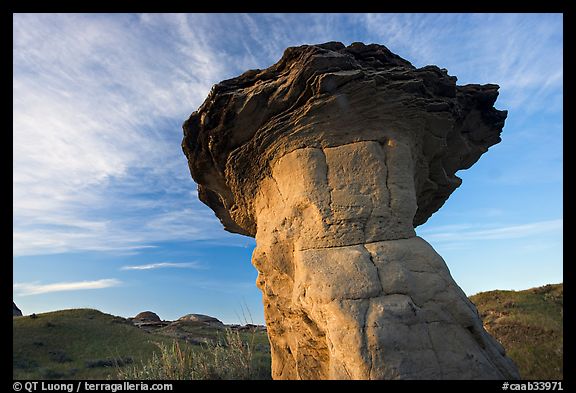
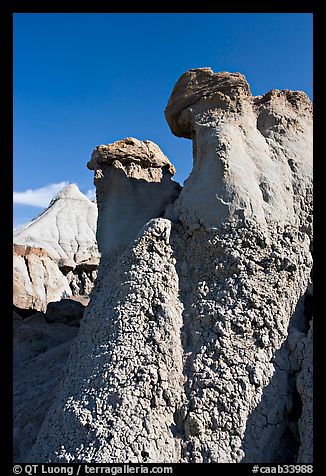
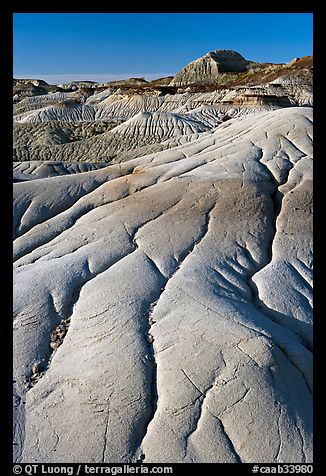
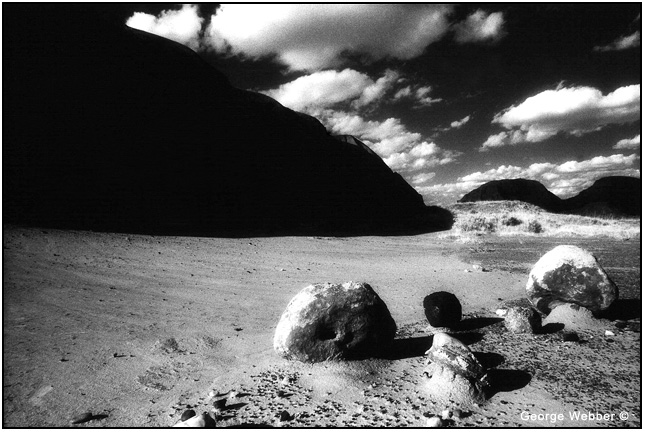
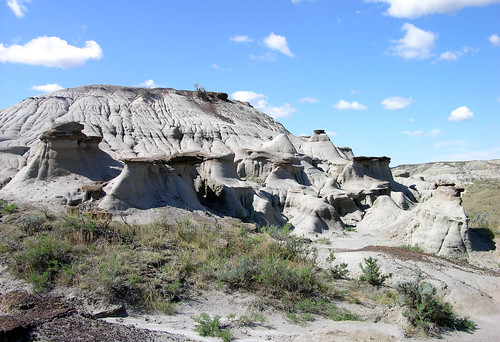
Seventy-five million years ago during Cretaceous times, the area was a low-lying marsh at the mouth of a river flowing into the Bearpaw Sea. The Bearpaw was the last in a succession of vast seas that covered the interior plains for 30 million years. Swamp grasses and reeds grew in the wetlands, whereas on higher ground, giant redwoods and palms towered over a dense forest. Dinosaurs flourished in this subtropical environment. More than millions of years ago, great quantities of silt and mud were flushed downriver, building up a delta at the edge of the sea. In time, this delta hardened, and the countless layers formed sedimentary rock. Soon after, great pressures beneath the earth's surface pushed the crust upward, forming a jagged mountain range that we know today as the Rocky Mountains. This event dramatically changed the climate of the plains region from tropical to temperate, probably killing off the dinosaurs approximately 64 million years ago. From then until one million years ago, the climate changed many times until the first of many sheets of ice covered the plains. As the final sheet receded, approximately 15,000 years ago, millions of liters of sediment-laden meltwater scoured the relatively soft bedrock into an area we know as the badlands. The erosion process continues to this day, no longer by the action of glacial meltwater but by rain and wind. The carving action has created a dramatic landscape of hoodoos, pinnacles, mesas, and gorges in the sandstone here, which is 100 times softer than that of the Rockies. The hills are tiered with layers of rock in browns, reds, grays, and whites. Many are rounded, some are steep, others are ruddy and cracked, but they all have one thing in common--they are laden with dinosaur bones. As the Red Deer River curves through the park, it cuts deeply into the ancient river delta, exposing the layers of sedimentary rock and revealing the once-buried fossil treasures.


FIELDWORK IN THE PARK

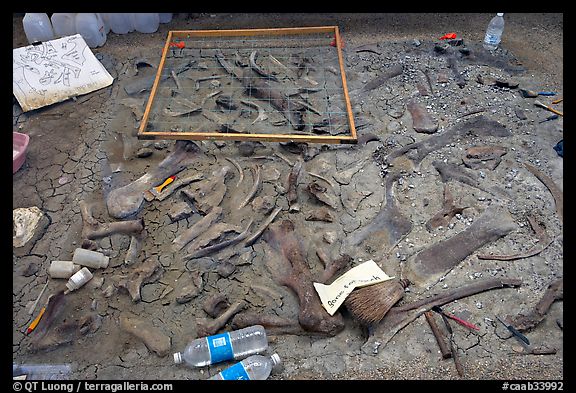
Each summer, paleontologists from around the world converge on the park for an intense period of digging that starts in late June and lasts for approximately 10 weeks. The earliest dinosaur hunters simply excavated whole or partial skeletons for museum display. Although the basic excavation methods haven't changed, the types of excavation have. "Bonebeds" of up to one hectare are painstakingly excavated over multiple summers. Access to much of the park is restricted in order to protect the fossil beds. Digging takes place within the restricted areas. Work is often continued from the previous season, or new sites are commenced, but there's never a lack of bones. New finds are often discovered with little digging, having been exposed by wind and rain since the previous season. Excavating the bones is an extremely tedious procedure; therefore, only a few sites are worked on at a time, with preference given to particularly important finds such as a new species. Getting the bones out of the ground is only the beginning of a long process that culminates with their scientific analysis and display by experts at museums around the world.


EXPLORING THE PARK

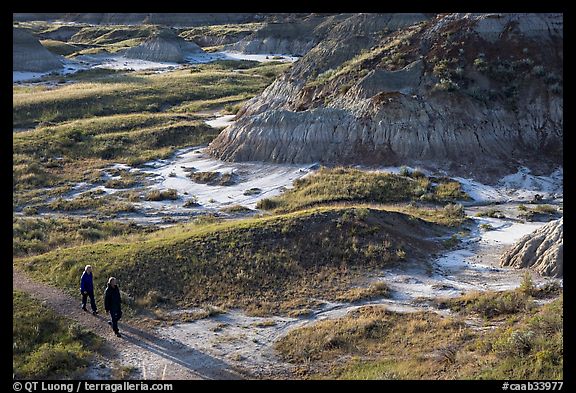
Much of the park is protected as a Natural Preserve and is off-limits to unguided visitors because current excavations are taking place. The Natural Preserve protects the bonebeds and the valley's fragile environment. It also keeps visitors from becoming disoriented in the uniform landscape and ending up spending the night among the bobcats and rattlesnakes. The area is well marked and should not be entered except on a guided tour. One other important rule: Surface collecting and digging for bones anywhere within the park is prohibited.

Interpretive Programs and Tours

Even though much of the actual digging of bones is done away from public view, the Field Station of the Royal Tyrrell Museum (403/378-4342, July-Aug. daily 8:30 a.m.-9 p.m., Sept. to mid-Oct. daily 9 a.m.-5 p.m., and the rest of the year, weekdays 9 a.m.-4 p.m., adult $3, senior $2.50), organizes enough interesting activities and tours to keep you busy for at least a full day. The Field Station offers many interesting displays, including complete dinosaur skeletons, murals, and models, and is the departure point for tours into the park. The Badlands Bus Tour takes you on a two-hour ride around the public loop road with an interpretive guide who will point out the park's landforms and talk about its prehistoric inhabitants. The Centrosaurus Bone Bed Hike takes visitors on a 2.5-hour guided hike into a restricted area where more than 300 centrosaurus skeletons have been identified. The Camel's End Coulee Hike is an easy 2.5-kilometer (1.5-mile) guided walk to discover the unique flora and fauna of the badlands. Finally, a tour of the Field Station Laboratory is offered daily at 1:30 p.m. Space on all of these tours is limited. The laboratory tour is $2. Each of the other tours costs $6.50. The tours are very popular, and this is reflected in the procedure for purchasing tickets. Tour tickets go on sale May 1 and must be picked up 30 minutes before the departure time. To reserve a seat, call 403/310-0000 May-Aug. Mon.-Fri. 9 a.m.-4 p.m. Some tickets are reserved for the day of the tour and sold as "rush" tickets (be at the Field Station when it opens at 8:30 a.m. to ensure that you get a ticket). Finally, if seats become available through no-shows, you make snag a seat at the last minute. Documentaries are shown at the Field Station in the evenings, and special events are often staged somewhere in the park. The entire interpretive program operates in summer only, with certain tours offered in late May and September.

On Your Own

You may explore the area bounded by the public loop road and take three short interpretive trails on your own. The loop road passes through part of the area where bones were removed during the Great Canadian Dinosaur Rush. By staying within its limits, hikers are prevented from becoming lost, although the classic badlands terrain is still littered with fragments of bones, and the area is large enough to make you feel "lost in time." It's a fantastic place to explore. Of special interest are two dinosaur dig sites excavated earlier this century, one of which contains a still-intact skeleton of a duck-billed hadrosaur. The Badlands Trail is a 1.3-kilometer (0.8-mile) loop that starts just east of the campground and passes into the restricted area. The Coulee Viewpoint Trail, which begins behind the Field Station, climbs steadily for 500 meters (1,650 feet) to a high ridge above Little Sandhill Creek. This one-km (0.6-mile) trail takes 20 minutes. It's easy to ignore the nearby floodplains, but the large stands of cottonwoods you'll see were a contributing factor to the park being designated as a UNESCO World Heritage Site. The Cottonwood Flats Trail starts 1.4 kilometers (0.9 miles) along the loop road, leading through the trees and into old river channels that lend themselves to good bird-watching. Allow 30 minutes roundtrip.


PRACTICALITIES

Accommodations and Camping
The park's campground is in a low-lying area beside Little Sandhill Creek. It has 128 sites, pit toilets, a kitchen shelter, and a few powered sites. Unserviced sites cost $17, powered sites $20. The campground fills up by early afternoon. To book a site, call 403/378-3700. Alternatives are detailed under the Brooks section of this chapter. Aside from the regular motels in Brooks, old-time accommodations are provided at the Patricia Hotel (16 km/10 miles southwest from the park, 403/378-4647). Known for its Western atmosphere, the hotel has basic rooms with shared and private baths from $40 s, $45 d. In the downstairs bar, many of the cattle brands on the walls date back more than 50 years. Choose from buffalo burgers or steaks at the nightly cook-your-own barbecue.
Services and Information
The only commercial facility within the park is the Dinosaur Service Centre (403/378-3777), a fast-food place open limited hours each day. Within the center are laundry facilities and coin showers. No groceries are available in the park.


If you like this post just click here Posted By crkota with No comments
  • Popular
  • Categories
  • Archives