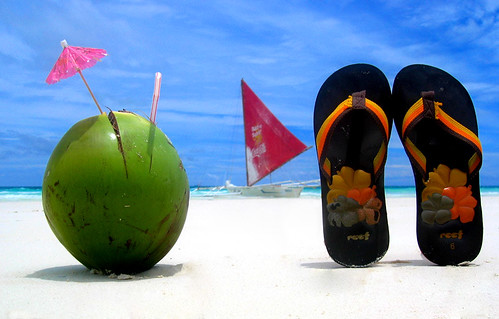
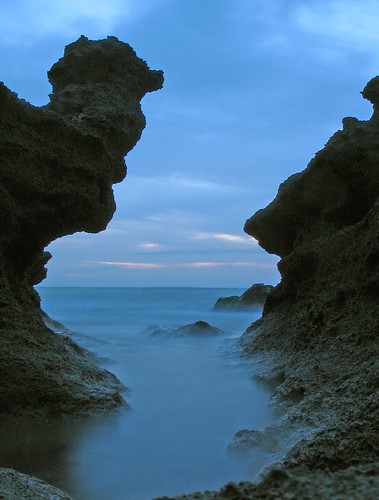
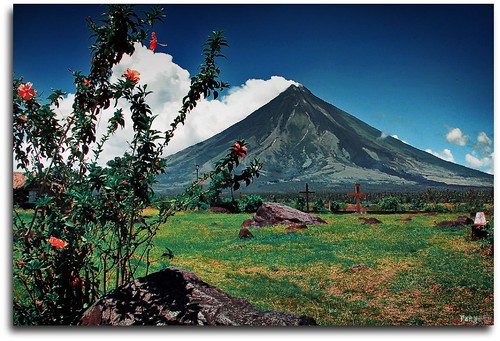
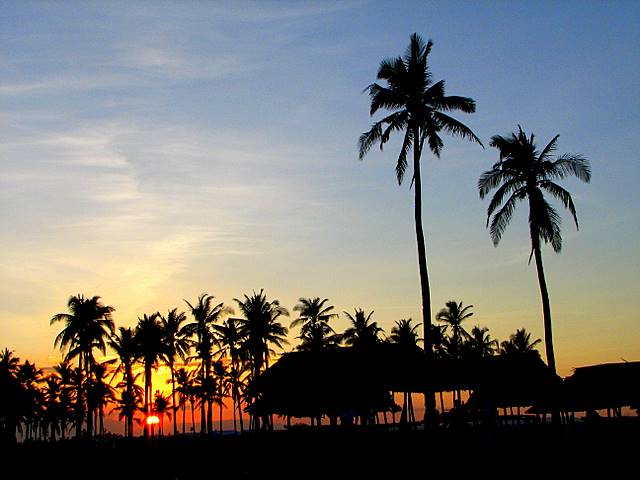
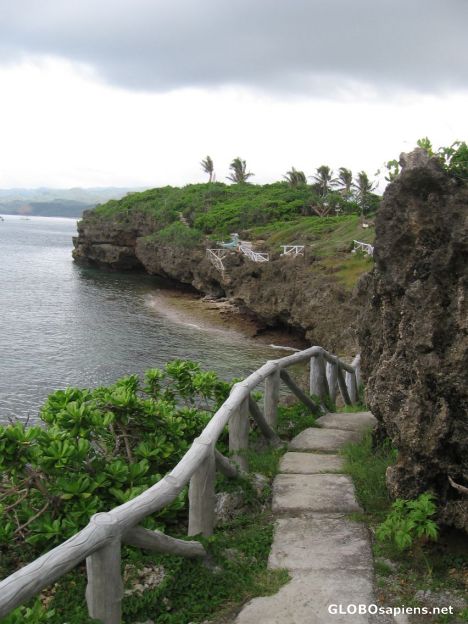
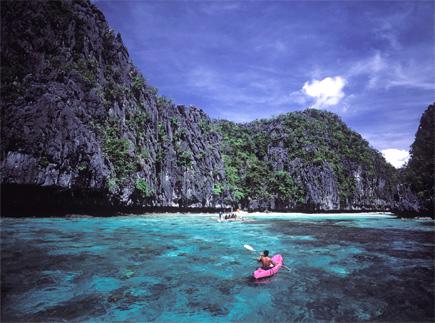
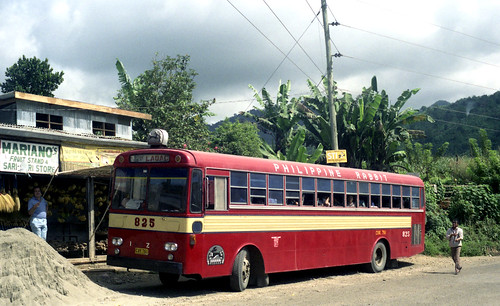
The Philippines archipelago of more than 7,000 islands is sandwiched between Malaysia, Indonesia, Vietnam and Thailand, flanked by the South China Sea. All her neighbors have magical tourist appeal to various degrees, but the Philippines, even though the sea is just as blue and clear and the myriad coral islands just as alluring, seems to have missed the boat when it comes to marketing its attractions.
Bad press in recent years, after some high-profile terrorism and kidnapping incidents, have not helped matters. The country has also labored under a turbulent political reputation and is still overcoming the effects of martial law. Its poor infrastructure, dilapidated roads and unsafe ferries, have also all played a role in deterring potential travelers and the country has been overlooked as an eco-tourist destination because of local disregard for the natural resources (such as fishermen dynamiting coral reefs). While resources are being channelled into education to prevent such practices a great deal of damage has already been done to the environment.
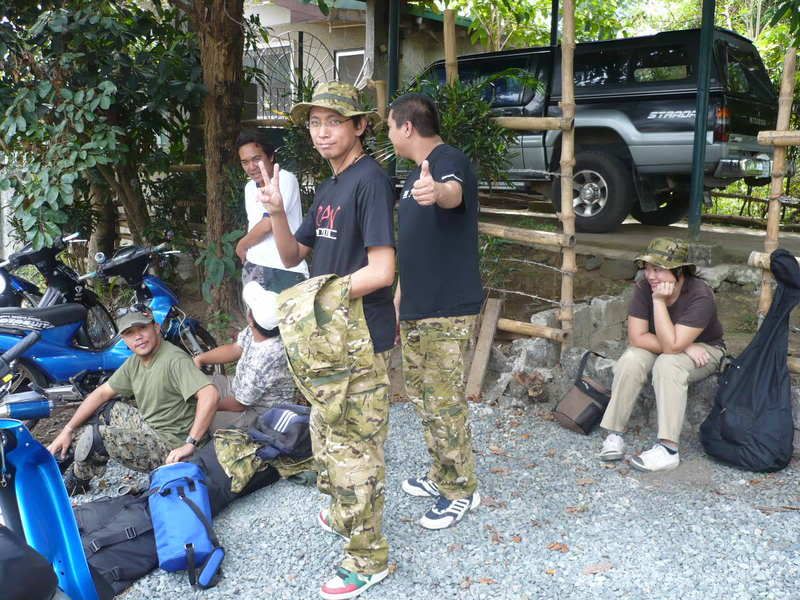
The good news is that Filipinos themselves are warm and welcoming - as underscored in the country's tagline - 'where Asia wears a smile'. Apart from some beautiful, remote tropical islands and legendary scuba diving spots, the archipelago's best resource is the friendliness and laid-back attitude of the Filipino people. Their hospitable and embracing attitude is enough to put a smile on any visitor's face; this is even more the case in the rural areas. The Philippines has some superb all-inclusive luxury resorts spread around the islands which cushion visitors from the general degradation and safety-risks of the cities and towns, and a major plus is that the country is amazingly good-value. Also, the food is delicious, and English is widely spoken.
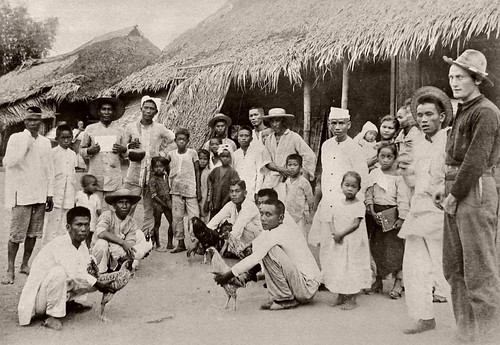
Independent travelers who like to wander off the beaten track, and do not mind doing without the conveniences of running water and the like, will find plenty to fascinate them in the countryside and coastal parts of the Philippines; albeit without the assistance of guide books. The Philippines is one of the few places left in the world where adventurers can wander through tribal lands, unfettered by modern interferences. Travelers are however advised to follow the current safety advice on areas to avoid.
During 2000 a Belgian research center declared the Philippines to be the most disaster-prone country on earth, citing typhoons, earthquakes, volcanic eruptions, floods, garbage landslides and militant action against Muslim insurgents as just some of it's problems! The current Government, however, is trying to improve this image, so now may be the time to see the country in its unspoilt state, before the major mass package resort developers move in.
Language: The official language of the Philippines is Filipino, but English is widely spoken. Tagalog is the most predominant of the many dialects or local languages spoken throughout the islands.
Currency: The currency of the Philippines is the Peso (PHP), which is divided into 100 centavos. Major credit cards are widely accepted in the cities and tourist destinations. Banks do not always accept travelers cheques, but a receipt of purchase is useful. ATMs are available in the major cities. US dollars are widely accepted in Manila and other tourist areas and are the easiest currency to exchange; otherwise Euros and Pounds Sterling can also be exchanged in banks and hotels. Banks open from 9am to 3pm, Monday to Friday, but their ATMs are open 24 hours. It is best to carry pesos when traveling outside of major centers.
Time: Local time is GMT +8.
Electricity: Electrical current is 220 volts, 60Hz. Two-pin flat blade attachments and two-pin round plugs are used.
Communications: The international access code for the Philippines is +63. The outgoing code is 00 followed by the relevant country code (e.g. 001 for the United States). City/area codes are in use, e.g. (0)2 for Manila. The major towns, cities and popular tourist spots are covered by GSM 900 and 1800 mobile phone networks. Internet cafes are available in Manila and the tourist resorts.
Duty Free: Travelers to the Philippines over 18 years do not have to pay duty on 400 cigarettes or 50 cigars or 250g pipe tobacco; and 2 liters of alcoholic beverages. Prohibited items include firearms or parts thereof, explosives and ammunition; printed material that contains subversive, obscene or pornographic content; drugs, gambling machines, lottery sweepstake tickets, or coin-operated video machines; gold, silver and other precious metals that do not have authentication of quality; non-identifiable brands of medicines or foodstuffs; coca leaves and any prohibited drugs; plants or parts thereof, fruits and vegetables.
Everyone entering the Philippines must have a passport valid for at least six months beyond the intended period of stay (some exceptions are possible). All visitors must have return or onward tickets, documents necessary for further travel, as well as sufficient funds. A visa is not required for a stay of up to 21 days provided these criterion are met. Extensions for visas are possible and should be made with the Bureau of Immigration.
Americans: United States citizens must have a valid passport. No visa is required for a stay of up to 21 days.
UK nationals: British citizens must have a valid passport. No visa is required for a stay of up to 21 days, unless passport is endorsed British National (Overseas) issued in Hong Kong, in which case no visa is required for a maximum stay of seven days.
Canadians: Canadians must have a valid passport. No visa is required for a stay of up to 21 days.
Australians: Australians must have a valid passport. No visa is required for a stay of up to 21 days.
South Africans: South Africans must have a valid passport. No visa is required for a stay of up to 21 days.
Irish nationals: Irish citizens must have a valid passport. No visa is required for a stay of up to 21 days.
New Zealanders: New Zealand nationals must have a valid passport. No visa is required for a stay of up to 21 days.
HealthNo special vaccination certificates are required, except by travelers entering the Philippines from an area infected with yellow fever. Recommended vaccinations include typhoid as there are frequent outbreaks of typhoid fever. There is a malaria risk in parts of the Philippines and visitors should seek medical advice before traveling; urban areas are generally considered risk-free. Dengue fever is a risk throughout the country; the best prevention is to avoid mosquito bites. Tap water is not safe to drink and ice in drinks should be avoided; cholera is a risk in the country and precautions are advised. Sea snakes can be highly venomous; travelers should be cautious in remote coastal waters, lakes and rivers, as anti-venom may not be readily available. Medical care is good in the major cities, although very expensive, however it is limited in the remoter areas. Comprehensive medical insurance is advised.
SafetySafety and security should be of paramount concern to any visitor to the Philippines. It is vital to be fully informed of threats and developments regarding crime, terrorism and kidnapping before and during a visit to the islands. Vigilance is vital throughout the islands, particularly in Manila, as opportunistic crimes are motivated by circumstances of poverty. Extremist groups have a history of kidnapping foreign tourists, and terrorist bombings have occurred in Manila and Mindanao, targeting transport and public places. Recent explosions in Mindanao have killed and injured many people. Security has been increased across southern Philippines, and many foreign governments have issued warnings against traveling to Mindanao. Terrorist groups have also threatened to attack passenger ferries and other vessels, particularly those operating from Mindanao. The threat of terrorism and kidnapping is greatest in central, southern and western Mindanao, Basilan, Tawi Tawi, Jolo and the Sulu archipelago; the FCO, US Department of State and other governments advise against all travel to these areas, and care should also be taken in Palawan and at coastal resorts and tourist centers throughout. There is a high incidence of piracy and armed robbery against ships in and around Philippine waters, and a risk of kidnappings at sea. It is believed that terrorists are continuing with plans to kidnap foreigners from the islands and coastal areas in southern Philippines, putting all boats traveling to and from offshore islands in the Mindanao and the Sulu archipelago, as well as at dive sites at great risk. Safety standards on ferries are low, and rescue services are not very comprehensive. It is advisable to avoid travel off the beaten track, and to leave travel plans with friends, colleagues or relatives. The area is prone to typhoons between July and November, when flooding and landslides can occur; Typhoon Fengshen in June 2008 caused flash floods, landslides and rough seas that has lead to hundreds of deaths.
ClimateThe Philippines has a tropical marine climate dominated by a rainy season and a dry season. The summer monsoon brings heavy rains to most of the country from May to October, and the winter monsoon brings cooler and drier air from December to February. Manila and most of the lowland areas are hot and dusty from March to May, when temperatures can rise to around 99°F (37°C). Average sea-level temperatures rarely drop below 80°F (27°C). Monsoons are possible between July and October.
DivingThe Philippines is considered a world-class diving destination. The islands have one of the most productive marine ecosystems in the world, a wonderful diversity of more than 800 types of colorful corals, and a vast array of marine life that exists beneath its deep blue waters. There are a number of dive sites throughout the islands that suit either beginners or expert divers. The best known of these are Batangas, Boracay, Cebu, Mindoro and Palawan, most of which are within easy-reach from Manila.
IntramurosCity/Region: Manila
The oldest part of Manila is the medieval Spanish walled enclave of Intramuros on the southern bank of the Pasig River, packed with historic buildings and churches, many of which are being or have been restored. The reconstruction of Intramuros has allowed for the inclusion of several parks and performing venues, art galleries, souvenir shops and restaurants, so that the area has become an attractive, entertaining and interesting tourist Mecca. Fort Santiago, for example, was where political prisoners through the ages, from Spanish to Japaneseoccupation, were held, tortured and sometimes executed. Today it is a lush park full of flowering trees and homing pigeons where visitors can take a ride along the promenade on a horse-drawn carriage. Then, in the Barrio San Luis along Juan Luna Street there are five colonial residences that have been beautifully restored.
Rizal ParkCity/Region: Manila
The 58-hectare (143 acre) Rizal Park is named for Dr Jose Rizal, renowned Philippine anti-colonialist, writer and philosopher. The park is one of the largest in South East Asia, and is a green lung much used by the residents of Manila for recreation and entertainment. The park features numerous ornamental gardens, a chess plaza and a skating rink. In a pond on the east side of the park the Philippines archipelago has been recreated in miniature. There are also some museums and public buildings within the park, and after sunset a sound and light exhibit featuring the martyrdom of Dr Jose Rizal is to be seen. On Sundays there is a free concert in an open-air auditorium.
Hours: Daily 7am to 7pm
Admission: Free
San Agustin ChurchCity/Region: Manila
Within Intramuros stands Manila's oldest stone church, San Agustin, which was completed in 1606 and has since survived the ravages of time and successive invasions. The church has a magnificent intricately carved door, Baroque pulpit, and an 18th century pipe organ. A museum is housed in the Monastery alongside the church, which holds a collection of paintings of saints and other religious art. The Sacristy houses a collection of richly embroidered vestments and Philippine notables are buried in the crypt.
Address: Calles Gen Luna and Real
Phone Number: (0)2 527 4060
Hours: Daily 7am to 7.30am and 5pm to 6pm. The museum is open daily 9am to 12pm and 1pm to 5pm
Admission: Museum: P45
National Museum of the PhilippinesCity/Region: Manila
The large and comprehensive National Museum of the Philippines preserves and showcases the cultural, historical and natural heritage of the islands with collections housed in two different buildings (within Rizal Park). Exhibits are categorised in five divisions: art, botany, zoology, geology and anthropology. Among the many archaeological exhibits is the skull of 'Tabon Man'; the oldest human remains found in the archipelago. The section devoted to the Filipino People includes the preserved remains and treasures of the San Diego Spanish galleon that sank in Philippine waters in 1600.
Address: Padre Burgos Street, Rizal Park
Phone Number: (0)2 527 1215
Email Address: nmuseum@i-next.net
Hours: Tuesday to Sunday 9am to 5pm
Admission: Free
Malacanang PalaceCity/Region: Manila
The name of this Palace, now the seat of government and official residence of the Philippines head of state, comes from the vernacular 'May Lakan Diyan', which means 'there lives a noble man'. This gracious villa has been a noble residence on the north bank of the Pasig River since the 18th century, when it was built for a Spanish aristocrat. In 1825 the Spanish Government bought the property as a summer house for the Governor General, but it later became the permanent seat of the head of state. There is now a museum housed in the palace that features mementos from each of the Philippine's presidents, including the notorious Ferdinand and Imelda Marcos.
Address: JP Laurel Street, San Miguel
Phone Number: (0)2 733 3721
Hours: Monday to Friday 9am to 3pm
American Cemetery and MemorialCity/Region: Manila
Providing a quiet spot to retreat from Manila's rat race, the American Cemetery near the Makati commercial center is a welcome peaceful oasis, much visited by tourists, especially veterans of World War II. The hillside cemetery contains thousands of white marble crosses marking rows of graves of those who died in battle. The circular memorial contains the names of those missing in action engraved in marble columns; huge wall mosaics depict battle scenes from WWII, and a small chapel is located here.
Las PinasCity/Region: Manila
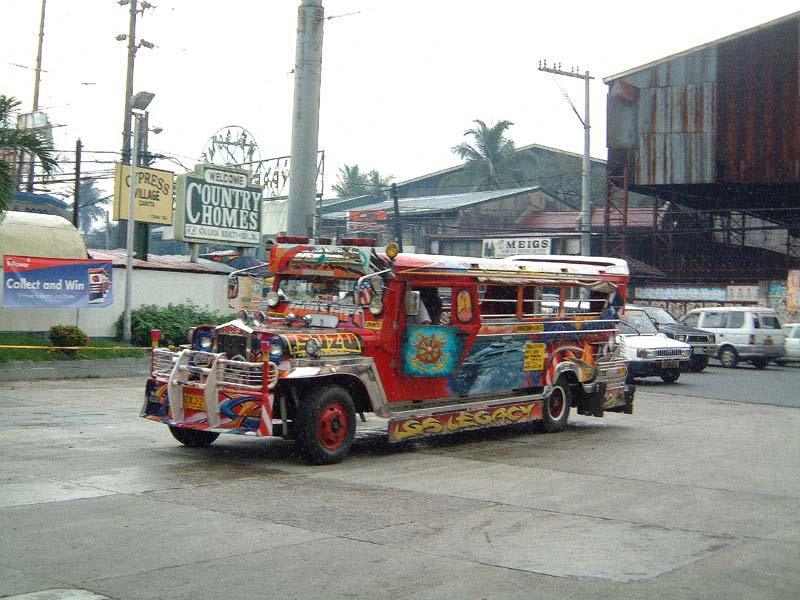
Although the village of Las Pinas, 12 miles (20km) from the center of Manila, has now been swallowed up in the suburban sprawl of the city, it has kept its character and is a favored stop on most tours of Luzon because of its famous bamboo organ. The organ is housed in the San Jose Church, and has a very unique sound that draws international organists here every year in the second week of February for an Organ Festival. Another attraction at Las Pinas is the Sarao Jeepney Factory, where visitors can watch these unique Filipino vehicles being assembled and learn how they came to be the favored form of transportation on the islands.
Transport: Half-hour bus journey from the city center
Hours: San Jose: Monday to Saturday 9am to 4pm. The organ can be viewed Monday to Friday 8am to 12pm
CorregidorCity/Region: Manila
This small island, shaped like a tadpole, has become a memorial and open-air museum commemorating the World War II stand of Filipino and American troops against the Japanese invaders. The island is the largest of several at the entrance to Manila Bay, laying off the tip of the Bataan Peninsula, about 26 miles from the city. Its strategic position made it a prime candidate for the last stand against the Japanese in the Pacific War, and its three and a half square miles (9 sq km) of dry land remains littered with the detritus of battle. Guided tours of the island are available by arrangement with the Corregidor Visitor's Information Center in Manila.
Phone Number: (0)2 834 5048
Website: www.corregidorphilippines.com
Transport: There are ferry services from Manila
Tagaytay CityCity/Region: Manila
Tagaytay is one of the most visited tourist destinations in the Philippines, famous for the Taal Volcano. The volcano is unique in that it sits on an island in a lake, and has another lake within its vast crater. The views from the ridge on the access highway to the volcano are legendary and breathtaking. Tagaytay itself provides plenty of recreation opportunities and good hotels and restaurants because it is the favored 'summer capital' for Filipinos wishing to escape the capital during the unpleasant summer heat. Other sights in Tagaytay are the 'Palace in the Sky', an unfinished complex originally meant to be a home for former president Marcos and now used as a viewpoint and park; and the huge flower farm, abloom all year round, on a slope at Barngay Guinhawa.
Website: www.tagaytay.com
Transport: Bus from the center of Manila (about 45 minutes)
BanaueCity/Region: Manila
This fascinating region in northern Luzon is known for being largely untouched by Western civilization and gives a glimpse of the true Philippines. In a string of villages around Banaue people live according to age-old tribal traditions. The main attraction in the area is the Banaue Rice terraces, dubbed the 'eighth wonder of the world'. Constructed about 3,000 years ago the terraces start from the base of the Cordillero Mountains and extend upwards for thousands of feet, cleverly irrigated by channelled streams and springs. The terraces bear testimony to the ingenuity of the ancient Ifugao people. There are more terraces at Batad village, which also sports a waterfall and natural swimming pool, and at Sagada there are a series of ancient burial caves in the mountainside with the famous 'hanging coffins' perched on limestone outcrops.
Transport: From Manila it is a 10 hour drive. Take public utility buses saying Manila-Banaue, such as Auto Bus. From Bagbag airport it is a two to three hour drive, with public buses or jeeps
Subic Bay Freeport ZoneCity/Region: Manila
Subic Bay is a unique project on the site of a former United States Naval base. It was buried under ash after the eruption of Mt Pinatubo in 1991 and has since been transformed into a buzzing eco-tourism and commercial hub, only five minutes from the Philippines International airport and a two-hour drive northwest of Manila. Most of the area, which is enclosed by a security fence, is covered in dense forests teeming with flora and fauna, including rare butterflies and bats. There are also lovely unspoiled beaches to enjoy, exceptional scenery, forest trails, watersport activities, coral reefs and shipwrecks to explore, numerous sports facilities and duty-free shopping centers.
Puerto GaleraCity/Region: Manila
Puerto Galera on the island of Mindoro consists of several towns and beach resorts that have melded together on a protruding piece of land shaped like a whale's tale, to form the Philippines' fifth largest urban area. The Spanish traders used the natural harbor created from the land formation as a refuge in the 16th century, hence the name, which means 'Port of Galleons'. Puerto Galera was declared a protected area in a UNESCO program back in the 1970s. This put the area on the tourist map and helped with the resurgence of interest in its marine life and coral reefs, which had been suffering because of dynamite fishing. Puerto Galera is now one of the most sought-after scuba diving locations in the world, and the island of Mindoro also offers some rewarding hiking trails. There are more than 30 dive sites within 10 minutes of the three main beaches; deep trenches and vibrantly colorful reefs characterize the waters, along with numerous wrecks, a shark cave and a true wall with a 164ft (50m) drop-off.
PalawanCity/Region: Manila
The island of Palawan is an elongated stretch of thickly forested landscape bordered by coves, beaches, lagoons and limestone cliffs, stretching from southwest of Luzon towards Malaysia. The island's Tubbataha Reef is extremely ecologically important to the Philippines as a feeding ground and nursery for marine life, and the area is archaeologically important too. Caveman remains have been discovered on the island dating back 22,000 years. The main attraction on the island, however, is the underground river, St Paul's Subterranean Cave near Sabang, about two hours by road from Puerto Princesa. The cave extends more than five miles (8km) and contains the world's longest underground river. Palawan is still 'off the beaten track' but it can be reached by a flight from Manila.
Transport: By air from Manila to the island's airport at Puerto Princesa. There are also regular ferry sailings to and from the capital
Basilica Minore de Santo NinoCity/Region: Cebu
The oldest religious relic in the Philippines, an icon of the infant Jesus, is housed in the basilica, having miraculously survived fire and other catastrophes through the years since the image of Christ was first presented by Magellan to Queen Juana in 1521. The church itself was originally built in 1565, but was rebuilt in 1602 after a fire.
Fort San PedroCity/Region: Cebu
Fort San Pedro, located at Cebu City's wharf area, was the nucleus of the first Spanish settlement in the country. It began as a single triangular bastion, built in 1565, and was not completed for another 200 years. Over the centuries the fort has been put to several uses, including a watch-tower to counter pirate attacks in the 1700s, a prison for local rebels during the Philippine revolution, a US army barracks, and during world war II a prison camp. Today the fort has been turned into a museum-park, giving visitors to Cebu a glimpse of the island's history.
Hours: Monday to Saturday from 8am to 5pm
Admission: Free
Jumalon MuseumCity/Region: Cebu
Located in the Basak district, this private museum created by late lepidopterist, Professor Julian Jumalon, houses his unusual collection of mosaics, made up of butterfly wings. The garden of Jumalon's home continues to be a haven for thousands of butterflies, and the 'lepido mosaics' are displayed in the salon.
Address: 20 D Macopa Street, Basak
Phone Number: (0)32 91029
Hours: By appointment
Casa Gorordo MuseumCity/Region: Cebu
The Casa Gorordo Museum was originally the home of the first Filipino Bishop of Cebu. It is now restored and serves as a re-creation of a typical Filipino home of the late 19th century, furnished with religious relics, paintings, antique furniture and household items. The museum also showcases some contemporary art exhibits.
Address: 35 Lopez Jaena Street
Hours: Mondays to Saturdays 9am to 12pm and 2pm to 6pm
Admission: P15 (adults) and P5 (children)
BeachesCity/Region: Cebu
Numerous islets and beaches are connected to, or easily accessed from, the Cebu metropolitan area as day trips. Mactan Island is linked to Cebu City by a bridge and is the site of hundreds of beach resorts, most of which offer full scuba services and watersports facilities. Olango Island offers pristine white sandy beaches, while Kansatik, southeast of Olango, features an underwater mountain festooned with coral, sponges and colorful fish. Olango is also a paradise for bird watchers. A short drive north of Cebu City is Sagod, offering caves, beautiful beaches and some excellent dive spots. Capitancillo Islet, a little further northeast of Sagod, sits at the center of a coral reef that extends for about two miles (3km). Calanggaman Islet, in the same area, features black coral and caves. Gato Islet has lagoons, coral reefs and a sea-snake breeding ground. On the south-western shore of Cebu Island is Moalboal, another world-renowned dive destination, and Badian Island nearby has more underwater attractions and a five-star beach resort. Sun seekers also relish Argao, about two hours drive from Cebu City, where the beaches of Kawit, Mahawak and Mahayahay are picture-perfect.
BoracayCity/Region: Cebu
The tiny butterfly-shaped island of Boracay in the western Visayas has been 'discovered' by trendy international sun-lovers, and has become the Philippines' most popular beach destination. Thousands have sung the praises of the white, talcum-fine powder sand on a two-mile (4km) stretch of palm-studded beach that is said to glow at night, while the crystalline sea reflects the color of the unblemished blue sky. Despite its popularity Boracay remains unspoilt, offering a range of about 350 hotels and guesthouses, nightlife, good restaurants and a huge array of water sports. The island code is barefoot and informal, and the transitory holiday population come from all over the globe.
Website: www.boracayisland.org
Transport: Flight from Manila (one hour) or Cebu to Kalibo or Caticlan
BoholCity/Region: Cebu
The island province of Bohol is one of the loveliest in the Visayas group and lies southeast of Cebu. It has plenty to offer in the form of historical and natural attractions. The world's rarest seashells, like the Gloria Maris and the Golden Cowrie, can be found here, as well as the tarsier, the large-eyed insect-eating monkey which, fully grown, is smaller than a child's fist. Here too are the world-famous Chocolate Hills, a surreal series of 1,768 hills that resemble scoops of chocolate ice cream; they were formed from the weathering of coral deposits formed when the land was submerged and can be viewed from an observation deck. Historically Bohol labored under 302 years of Spanish rule after the local chieftain signed a 'blood contract' and many buildings, particularly beautiful churches, remain as testimony to the period of colonial rule and the struggle to be free of domination.
Website: www.bohol.ph
Transport: Ferry or privately-run scheduled boat from Cebu City to Tagbilaran City, capital of Bohol Island (about 90 minutes)
Davao MuseumCity/Region: Davao
About seven miles (12km) from the Davao City center at Insular Village, Lanang, the Davao Museum is devoted to showcasing the various tribal cultures of the people of the region. The main gallery is a repository of tribal art, local costumes, jewelry and handcrafts. There is also a gallery of paintings, sculptures and ceramics, and a souvenir shop sells native crafts. Tribal women can be seen at work at the nearby T'Boli Weaving Center weaving cloth from the fibers of the native abaca plant, featuring patterns that depict the folklore of the tribe.
Address: Zonta Bldg, Insular Village Phase I, Lanang
Hours: Monday to Saturday from 9am to 5pm
San Pedro CathedralCity/Region: Davao
Davao City's oldest church is named for the city's patron saint. Don Jose Uyanguren, known as the 'Spanish Conquistador of Davao', built it in 1847 during the Spanish colonial period. The original altar, carved with images of saints, has been preserved and can be seen in the right wing of the cathedral.
Address: Corner of San Pedro Street and CM Recto Avenue
Philippine Eagle CenterCity/Region: Davao
The powerful, large Philippine eagle (also known as the monkey-eating eagle) is found only in the mountains of eastern Luzon in the north of the archipelago, and in the heavily forested area of Mindanao. The breeding camp for these magnificent predators is sited at Malagos, in Calinan near Davao City. Also at Malagos is an orchid farm, sanctuary of Philippine native orchids, which offers a restaurant and swimming pool as part of its facilities.
Phone Number: Philippine Eagle Foundation: (0)82 224 3021
Website: www.philippineeagle.org
Transport: Buses depart for Calinan every 15 minutes from the Annil Terminal located at corner Quirino and San Pedro Extension in Davao. Bus fare is P30. From Calinan, take a pedicab to the PEC for P6
Hours: Daily 8am to 5pm
Admission: P50 (adults), P30 (children). The Davao City Water District also collects a fee on entrance of P5 for adults and P3 for kids
Samal IslandCity/Region: Davao
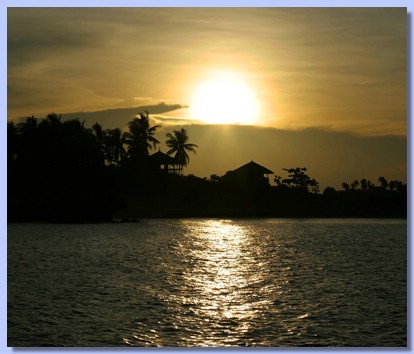
Just a short ferry ride south of Davao City, in the Davao Gulf, is the island of Samal, part of an archipelago of islets that offer a getaway from city life and some adventure activities. The island offers fabulous sunrises and sunsets and a fascinating topography of rolling hills, white sandy beaches and dozens of caves, which are popular with spelunkers and hikers. The coastline has the usual coconut palms, mangrove swamps and coral reefs, together with some little fishing villages, washed by clear, clean water: all the delights of a tropical island within a stone's throw of the city.
Lake SebuCity/Region: Davao
The region of south Cotabato in Mindanao, several hours' journey from Davao City, is for those who are courageous enough to seek 'off the beaten track' eco-adventures. Lake Sebu, near the village of Suralla, is surrounded by rolling hills and forested mountains, home to the T'boli, a highland tribe famous for their colorful costumes, intricate beadwork, woven work and brass ornaments, as well as the Tasadays, a cave-dwelling people. The area abounds with waterfalls, natural caves and springs.
CamiguinCity/Region: Davao
The tiny island of Camiguin, on the north coast of Mindanao, is renowned for the friendliness of its people, epitomised in its lively annual festival dedicated to the humble lanzones fruit, which is one of the island's major sources of income. Fruity and friendly this pear-shaped island certainly is, but it also has some other attractions to recommend it. There are no less than seven volcanoes, some still active; a multitude of hot springs; stunning beaches and offshore islets; and a spring that emanates natural soda water. The island has 35 resorts and plenty of restaurants. Mambajao is the capital, situated on the north coast. Most popular pursuits on the island (apart from enjoying the beaches) include climbing Mount Hibok-Hibok, an active volcano that last erupted in 1951 leaving a death toll of 500; snorkeling through the sunken cemetery at the barrio of Bonbon; reading gravestones that were submerged in a volcanic eruption in 1871; and taking a swim at Ardent Hot Springs, inland from Mambajao.
Website: www.camiguin.gov.ph
Transport: There is regular sea and air transportation from Cebu


 took an apple from the tree you would have thought he had robbed the garden of the Hesperides. His joy knew no bounds, and as soon as he got home, he ordered the servants to set a splendid repast on the table.
 Bacchus, merciful deity, heard and consented. "Go," said he, "to the river Pactolus, trace the stream to its fountain-head, there plunge in your head and body and wash away your fault and its punishment." He did so, and scarce had he touched the waters before the gold-creating power passed into them, and the river sands became changed into GOLD, as they remain to this day.
 umpire. Tmolus took his seat and cleared away the trees from his ears to listen. At a given signal Pan blew on his pipes, and with his rustic melody gave great satisfaction to himself and his faithful follower, Midas, who happened to be present. Then Tmolus turned his head toward the sun-god, and all his trees turned with him. Apollo rose, his brow wreathed with Parnassian laurel, while his robe of Tyrian purple swept the ground. In his left hand he held the lyre, and with his right hand struck the strings. Ravished with the harmony, Tmolus at once awarded the victory to the god of the lyre, and all but Midas acquiesced in the judgment. He dissented, and questioned the justice of the award. Apollo would not suffer such a depraved pair of ears any longer to wear the human form, but caused them to increase in length, grow hairy, within and without, and to become movable, on their roots; in short, to be on the perfect pattern of those of an ass.
 Mortified enough was King Midas at this mishap; but he consoled himself with the thought that it was possible to hide his misfortune, which he attempted to do by means of an ample turban or headdress. But his hairdresser of course knew the secret. He was charged not to mention it, and threatened with dire punishment if he presumed to disobey. But he found it too much for his discretion to keep such a secret; so he went out into the meadow, dug a hole in the ground, and stooping down, whispered the story, and covered it up. Before long a thick bed of reeds sprang up in the meadow, and as soon as it had gained its growth, began whispering the story, and has continued to do so, from that
 Midas was king of Phrygia. He was the son of Gordius, a poor countryman, who was taken by the people and made king, in obedience to the command of the oracle, which had said that their future king should come in a wagon. While the people were deliberating, Gordius with his wife and son came driving his wagon into the public square.
 took an apple from the tree you would have thought he had robbed the garden of the Hesperides. His joy knew no bounds, and as soon as he got home, he ordered the servants to set a splendid repast on the table.
 Bacchus, merciful deity, heard and consented. "Go," said he, "to the river Pactolus, trace the stream to its fountain-head, there plunge in your head and body and wash away your fault and its punishment." He did so, and scarce had he touched the waters before the gold-creating power passed into them, and the river sands became changed into GOLD, as they remain to this day.
 umpire. Tmolus took his seat and cleared away the trees from his ears to listen. At a given signal Pan blew on his pipes, and with his rustic melody gave great satisfaction to himself and his faithful follower, Midas, who happened to be present. Then Tmolus turned his head toward the sun-god, and all his trees turned with him. Apollo rose, his brow wreathed with Parnassian laurel, while his robe of Tyrian purple swept the ground. In his left hand he held the lyre, and with his right hand struck the strings. Ravished with the harmony, Tmolus at once awarded the victory to the god of the lyre, and all but Midas acquiesced in the judgment. He dissented, and questioned the justice of the award. Apollo would not suffer such a depraved pair of ears any longer to wear the human form, but caused them to increase in length, grow hairy, within and without, and to become movable, on their roots; in short, to be on the perfect pattern of those of an ass.
 Mortified enough was King Midas at this mishap; but he consoled himself with the thought that it was possible to hide his misfortune, which he attempted to do by means of an ample turban or headdress. But his hairdresser of course knew the secret. He was charged not to mention it, and threatened with dire punishment if he presumed to disobey. But he found it too much for his discretion to keep such a secret; so he went out into the meadow, dug a hole in the ground, and stooping down, whispered the story, and covered it up. Before long a thick bed of reeds sprang up in the meadow, and as soon as it had gained its growth, began whispering the story, and has continued to do so, from that
 Midas was king of Phrygia. He was the son of Gordius, a poor countryman, who was taken by the people and made king, in obedience to the command of the oracle, which had said that their future king should come in a wagon. While the people were deliberating, Gordius with his wife and son came driving his wagon into the public square.