Get widget

News

All kinds of news around the world in one place!

Studies

Explore with us and enjoy in that!

Encyclopedia

Start with us a journey through world of knowledge!

Travel

The world is beautiful. Let's peek into some magnificent places, and see what they offer!

Entertainment

Fun - because we have the right to be happy!

Lifestyle

Our life is adventure. Enjoy in every moment of that!

TOP 10

Amazing lists of incredible things!

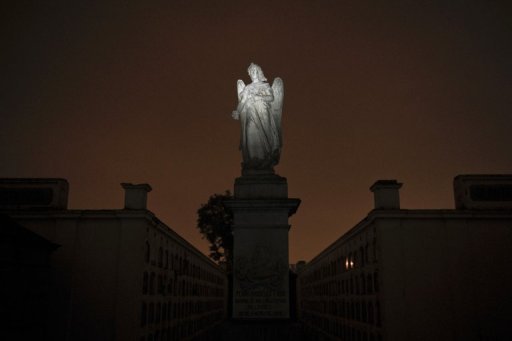
Spooky cemetery in Peru


The oldest cemetery in Peru has become a hit with tourists and locals.

The Presbitero Maestro Cemetery was built between 1805 and 1808 on the former outskirts of Lima and was the first municipal cemetery in Latin America. This impressive and beautiful historical Sanctuary houses the final resting places of many historical important personalities, but is still in use. The neoclassical complex contains the largest collection of 19th century European marble sculptures in Latin America. It’s absolutely worth seeing!

It was cold and dark, and people clutching lanterns in the moonlight gave a spooky cast to Peru's oldest cemetery, now Lima's oddball hit with locals and tourists. "It is scary. But we're into it," said a teenage girl clinging to her boyfriend as they walked through darkness and silence interrupted only by visitors' footsteps.
Each group has a guide who entertain visitors with tales about those buried at the Presbitero Matias Maestro Museum-Cemetery, a Peruvian national historical monument.

The cemetery covers an area of 25,000 m². It has 6 magnificent main gates and over 220,000 people found their final resting place at this outstanding burial ground. Although the Presbitero Maestro Cemetery was declared a National Historic Monument in 1972 the sculptures and the impressive mausoleums are threatened by natural aging, air pollution, pressure of the growing population and unfortunately by vandalism. At least the Public Beneficence Society of Lima tries to preserve this jewel of peace with a very tight budget.

Night tours are scheduled with different themes for different crowds: one focuses on love; another on patriotic fervor; still others on presidents; and inevitably one focuses on death itself. "What really brings in the most people is the tour focused on death, in November, and another on love, in February," says historian Jose Bocanegra, who has the historical details at the ready.

Some visitors are so apprehensive about being in a cemetery that they tiptoe around expecting something worthy of a horror movie. 
When tours started a decade ago they were limited to no more than 40 people; but they have become so popular that groups are now as large as 350 people, mainly young people and tourists, Bocanegra said.

One of the most popular tombs for local visitors is Peruvian poet Jose Santos Chocano, who asked to be buried standing, in a one square meter space. "So his coffin was placed in the niche vertically. And on his tombstone, there are lines from his poem 'Shipwrecked Life,'" Bocanegra said. "This square meter that I have looked for on Earth will be mine, if a bit late. Dead, in the end, I shall have it. ... I only expect now a square meter, where one day they'll have to bury me, standing," the poem reads.

It is a cemetery, and it is dark, to be sure. But there is enough light for visitors to stop and get a look at Carrara marble sculptures like the "La Dama de la Mantilla" (Lady in a mantilla) and "El bastón de Hermes" (Hermes' staff). Bronze works such as "A mother weeping at her son's tomb" and "A cry of pain" also are on display, steeped in the mood of the location, adorning mausoleums that are often caked in mud and apparently forgotten.

The cemetery, tucked into a corner of Lima's Barrios Altos district, was named for its designer, the priest Matias Maestro, who also was buried there. Opened in 1808 by Viceroy Fernando Abascal during Spanish colonial rule, the facility is a sort of history of Peru in tombs and crypts. Decorated with a staggering 940 sculptures -- some of them from as far away as Italy, by sculptors like Santo Varni, Pietro Costa, Ulderico Tenderini, and Rinaldo Rinaldi, or France's Jean Louis Barrias and Antonin Marcie.

The success of the tours is a blessing for the facility, providing a source of funding to care for tombs and sculptures that have themselves often seemed on their last legs.




If you like this post just click here Posted By crkota with No comments

Unknown Creature Discovered In Africa


Hunters in Namibia have caught strange creature that has never been seen before. Recording of events caused strong reactions - is a being from another planet, the mythical creature or something completely different?
Video showing the unusual creature caught in Africa has become a hit on the Internet in just a few days. In his description states that local hunters in Namibia saw a strange creature in search of food. One of the hunters had shot him, after which the creature fled into the bush, but hunters nevertheless find it.

Hunters have found three other similar beings. One of them attacked them, so they killed him, but the other escaped.
The body of of the weird being were taken away in a hunting camp and is expected to detailed investigation. People on YouTube have made ​​a discussion on the origin of this creature. While some believe that it is a fake photographs, others are convinced of their authenticity, and some even claim to have themselves seen similar being.
Watch the video and judge for yourself whether he is a being from another planet, the mythical creature or something else.


If you like this post just click here Posted By crkota with No comments

The Tormentor from Mareza


Shocking footage of animal torture in Montenegro, near Podgorica - the donkey was tied to a truck and dragged along the road. Eyewitnesses recorded the entire event and put on YouTube. The torturer is arrested.

V.S. (68) from Danilovgrad was arrested this morning on suspicion of having committed the crime of torture and killing of animals.
The police was announced that the VS tortured donkey on 18 August with a motor vehicle "TAM" '. In the footage is visible license plate number of the truck that the animal was tied - DG AG860.
Everything happened in a village Mareza.
The recording was titled "The Tormentor from Mareza", and caused a great condemnation on the Internet.


If you like this post just click here Posted By crkota with No comments

The World's Smelliest Man: this man has not bathed in over 38 years!


The world's smelliest man is Indian, Kailash Singh (66) who did not bathe in over 38 years. He listened to the priest's advice back in 1974., that would have a son if stop to take a bath!
Today he has seven daughters and still not giving up on a given testament.

More precisely, the priest has guarantee him a son if he stop to take a bath and to cut his hair.
- He said he would rather die than take a bath and that the only son could force him to change his opinion. It's been so many years that I have already got used to it, says wife Kalavati Devi.

Make no mistake, Kailash is still "cares about personal hygiene." Every night he performs "fire bath" to resolve the odor. His bath form includes smoking marijuana, including a prayer to God Shiva and dancing around the fire. He claims that in this way solves the stench, but his family and neighbors is absolutely disagree with that. 


Although the priest's advice was obviously not good, this man still refuses to bathe, and only son could force him to change his opinion. Of course, it is unlikely that they will have another child, given that his wife is now sixty years old. 


If you like this post just click here Posted By crkota with No comments

Unsuccessful test of hypersonic jet plane


U.S. military says that U.S. unmanned experimental spacecraft failed to achieve the planned rate six times greater than the speed of sound.
Hypersonic jet plane X-51 WaveRider was supposed to reach speeds of six Mach, or 5800 km / h when it was launched bomber B-52 off the coast of southern California. 


U.S. Air Force reported that due to errors in controlling the direction of X-51 WaveRider is lost in the Pacific.
"It is unfortunate that the problem with this subsystem caused the end before we could turn on the jet engine," said Charlie Brink of the research laboratories of the U.S. Air Force.
X-51 WaveRider successfully separated from the B-52 and launched the rocket engine after which it was supposed to be activated by a jet engine in order to reach a speed of six Mach. A control of a jet was lost 15 seconds later.

The U.S. Department of Defense tries supersonic technology to make missiles that could to arrive at any point on Earth in a few minutes.
U.S. Air Force was left with only one jet, X-51 WaveRider, but not decided whether it will be the flight test.


If you like this post just click here Posted By crkota with No comments

Naica Mine, The Cave of Giant Crystals, Mexico


The Naica Mine of Chihuahua, Mexico, is a working mine that is known for its extraordinary crystals.
With air temperature of 50C(122F) plus relative humidity of over 90% we get humidex value of 105C (228F) !!! This is one of the most extreme places on the planet.
Naica is a working mine and the only times you can get in is on Sundays and even then only if you know someone working at, or conected to the mines. The days of just suiting up and going in or long gone.

Naica is a lead, zinc and silver mine in which large voids have been found, containing crystals of selenite (gypsum) as large as 4 feet in diameter and 50 feet long. The chamber holding these crystals is known as the Crystal Cave of Giants, and is approximately 1000 feet down in the limestone host rock of the mine.

The crystals were formed by hydrothermal fluids emanating from the magma chambers below. The cavern was discovered while the miners were drilling through the Naica fault, which they were worried would flood the mine. The Cave of Swords is another chamber in the Naica Mine, containing similar large crystals.

The Naica mine was first discovered by early prospectors in 1794 south of Chihuahua City. They struck a vein of silver at the base of a range of hills called Naica by the Tarahumara Indians. From that discovery, until around 1900, the primary interest was silver and gold. Around 1900 large-scale mining began as zinc and lead became more valuable.

The huge mines at Naica have been excavated for years, but in 1975 a massive area was drained so mining operations could take place. When the water disappeared the crystals stopped growing, however, it was more than 25 years before two miners stumbled across the vast Crystal Caves and the incredible collection of gypsum was discovered. The formation of the beams 290 metres below the surface, occurred when super-heated water began cooling and became saturated with gypsum. Over time, crystals formed in the water. One of the major problems still facing scientists wishing to study below the ground at Naica is the heat. A hot spring located close to the Crystal Caves means the temperature is too hot for people to remain in the crystal chamber for longer than ten minutes at a time.

Just before the mine was closed, the famous Cave of Swords was discovered at a depth of 400 feet. Due to the incredible crystals, it was decided to try to preserve this cave. While many of the crystals have been collected, this is still a fascinating cave to visit. In one part there are so many crystals on one of the walls, they appear to be like an underwater reef moving in a gentle undulating motion in an ocean current.

In April 2000, brothers Juan and Pedro Sanchez were drilling a new tunnel when they made a truly spectacular discovery. While Naica miners are accustomed to finding crystals, Juan and Pedro were absolutely amazed by the cavern that they found. The brothers immediately informed the engineer in charge, Roberto Gonzalez. Ing. Gonzalez realized that they had discovered a natural treasure and quickly rerouted the tunnel. During this phase some damage was done as several miners tried to remove pieces of the mega-crystals, so the mining company soon installed an iron door to protect the find. Later, one of the workers, with the intention of stealing crystals, managed to get in through a narrow hole. He tried to take some plastic bags filled with fresh air inside, but the strategy didn't work. He lost consciousness and later was found thoroughly baked.
Momentarily, the penetrating heat is forgotten as the crystals pop into view on the other side of the "Eye of the Queen". The entire panorama is now lighted and the cavern has a depth and impressive cathedral-like appearance that was not visible on earlier trips with just our headlamps.
When inside the great cathedral of crystals, the pressure of intense heat create a gamut of emotions and perhaps hallucinations. One can only remain for a short period of time.

Ten years after the amazing discovery, scientists are petitioning the Mexican government to claim for Unesco World Heritage status to protect the unique formations for future generations.

It takes 20 minutes to get to the cave entrance by van through a winding mine shaft. A screen drops from the van's ceiling and Michael Jackson videos play, a feature designed to entertain visitors as they descend into darkness and heat. In many caves and mines the temperature remains constant and cool, but the Naica mine gets hotter with depth because it lies above an intrusion of magma about a mile below the surface.
It is still incredibly hot in the cave due its proximity to a magma chamber, deep underground. The air temperature is 50C with a relative humidity of over 90%, making the air feel like an unbearable 105C (228F) Entering the cave without special protective suits can be fatal in 15 minutes. I will be entering the cave wearing a special cooling suit with chilling packs inside and a specialized backpack respirator which will allow me to breath chilled air. Even with all this equipment, I will still only be able to stay in the cave for no more than 45 minutes at a time.
In extreme heat, the body begins to lose higher brain functions which made the expedition much more difficult with the risk of falling into deep pits, or being impaled on a sharp crystal. All the camera gear needs to be slowly brought up to temperature beforehand by pre-heating it and most cameras with moving parts and tape mechanisms simply will not work at all.
It is as dangerous as it is beautiful.

Geologists report that these natural crystal formations are incredibly complex, yet so simple. They have a magical or metaphysical personality independent of their chemical structures. There is a magma chamber two to three miles below the mountain and that heat from this compressed lava travels through the faults up into the area of the mine. Super heated fluids carry the minerals the miners are seeking as well as form the crystals. The mine is ventilated; otherwise, it could not be worked. Some parts, however, are not air-conditioned, such as the Cave of the Crystals, and there you feel the heat from the magma deep below. The fluids travel along the Naica fault, enter voids in the bedrock, and then form entirely natural structures that are not easily explained scientifically.

In April 2000, the mining company became confident that the water table on the other side of the fault had been lowered sufficiently to drill. When they did this, it is almost as if a magical veil of reality was breached and an entirely new world was discovered. Two caverns filled with the Earth's largest crystals were immediately revealed. More discoveries are expected to be made in this magical kingdom of intense natural beauty.

Selenite, the gypsum crystal, named after the Greek goddess of the moon, Selene, due to its soft white light, is said to have many metaphysical and healing benefits. Selenite powder has been used cosmetically for thousands of years to enhance one's natural beauty. It is believed that this crystal assists with mental focus, growth, luck, immunity, and soothes the emotions.


If you like this post just click here Posted By crkota with No comments

Fukushima butterflies show signs of mutation


Exposure to the radioactive material that leaked from the damaged Japanese nuclear power plant Fukushima caused mutations among butterflies in Japan.

Scientists have noticed increasing number of mutations of legs, antennaes and wings of a butterflys, which were collected after the accident in Fukushima in March 2011. They argue that the relationship between mutations and radioactive materials is proved with laboratory experiments.

Two months after the accident in the Fukushima team of Japanese researchers has collected 144 adult butterflies of the species Zizeeria maha, within ten locations in Japan, including the area of ​​Fukushima. At the time when the accident occurred, the butterflies were in the form of larvae. In comparison of mutations in the butterflies from other locations was found that in regions with high levels of radiation insects have much smaller wings and improperly developed eyes.

From left to right, dented eyes, deformed left eye, deformed right palpus, and deformed wing shape.

"It has been believed that insects are very resistant to radiation. In that sense, our results were unexpected," said lead researcher Joji Otaki from the University of the Ryukyus, Okinawa. Professor Otaki and his associates continued to grow butterfly trapped in the laboratory which is 1750 kilometers away from Fukushima, where the radiation is almost not felt. They found that mutations in the next generation even stronger, as they become embedded in the genes of parents who used the contaminated feed.

Scientists have used this kind of butterflies as indicator of the environment, as previously known that these insects are very sensitive to changes in the nature.

"This study is important and overwhelming in its implications for both the human and biological communities living in Fukushima. These observations of mutations and morphological abnormalities can only be explained as having resulted from exposure to radioactive contaminants," explained University of South Carolina biologist Tim Mousseau, who studies the impacts of radiation on animals and plants in Chernobyl and Fukushima, but was not involved in this research. 


If you like this post just click here Posted By crkota with No comments

Please, kill yourself at home!


City of London has launched an unusual campaign, which recently shocked all those who ride the metro in the city. The campaign is called "Kill yourself at home" is intended to reduce the number of suicides, especially those occurring at the metro stations.

Apparently, a large number of suicides in London takes place in a public place, mainly in the subway, which is a trauma for both drivers and users of transport.

The management of London has decided to deal with this phenomenon, which is why the government taped posters on subway on which is the box with pills above which say "Kill yourself at home.", while the fine print below explained: "Why would you jump, when it is easier to swallow. Our customers and drivers alike will be grateful."

How the campaign will be successful remains to be seen, in any case, this is a bizarre way.


If you like this post just click here Posted By crkota with No comments

World’s Earliest Prosthetics: Egyptian Mummy's Fake Toe


Two artificial big toes - one found strapped to the mummified remains of an Egyptian woman - may be the world's earliest functional prosthetic body parts, according to a study: the linen and plaster "Greville Chester toe," which dates back past 600 BC; and the wood and leather "Cairo toe," which was built between 950-710 BC.

A superbly preserved artificial big toe from the Cairo museum in Egypt was found in 2000 in a tomb near Luxor in the ancient necropolis of Thebes. Archaeologists speculated the 50- to 60-year-old woman the prosthesis came from might have lost her toe due to complications from diabetes.
 

The Greville Chester Great Toe also shows signs of wear, suggesting that it may have been worn by its owner in life and not simply attached to the foot during mummification for religious or ceremonial reasons. However, unlike the Cairo specimen, the Greville Chester Great Toe does not bend and so is likely to have been more cosmetic.


That would easily make it the most ancient replacement limb known, several centuries older that the Roman-era bronze-and-wood leg unearthed from a burial site near Capua, Italy.

Both replicas, which even look like toes, were tested on two volunteers who had lost their right big toes. Lead researcher Dr Jacky Finch, from the University of Manchester, carried out the tests in the Gait Laboratory at Salford University's Centre for Rehabilitation and Human Performance Research. Sure enough, the false toes offered greater mobility and comfort. Said Manchester study leader Dr. Jacky Finch in a recent article in The Lancet:

To be classed as true prosthetic devices any replacement must satisfy several criteria. The material must withstand bodily forces so that it does not snap or crack with use. Proportion is important and the appearance must be sufficiently lifelike as to be acceptable to both the wearer and those around them. The stump must also be kept clean, so it must be easy to take on and off. But most importantly, it must assist walking. The big toe is thought to carry some 40% of the bodyweight and is responsible for forward propulsion although those without it can adapt well [...]
My findings strongly suggest that both of these designs were capable of functioning as replacements for the lost toe and so could indeed be classed as prosthetic devices.
If that is the case then it would appear that the first glimmers of this branch of medicine should be firmly laid at the feet of the ancient Egyptians.

A three-part wood and leather artefact housed in the Egyptian Museum in Cairo, and the Greville Chester artificial toe on display in the British Museum, helped their toe-less owners walk like Egyptians.


If you like this post just click here Posted By crkota with No comments

TauTona Mine - World’s Deepest Mine


The TauTona Mine or Western Deep No.3 Shaft, located in South Africa, is the deepest gold mine in the world with miners working 2.4 miles below the earth’s surface. Known as one of the most efficient mining processes, 5600 miners roam through 500 miles of tunnels removing the gold containing ore.
The TauTona mine exists within the West Witts area slightly South West of Johannesburg in the North West of South Africa. The mine is near the town of Carletonville. TauTona neighbours the Mponeng and Savuka mines, and TauTona and Savuka share processing facilities. All three are owned by AngloGold Ashanti. 

The mine was originally built by the Anglo American Corporation with its 2 km (1.2 mi) deep main shaft being sunk in 1957. The mine began operation in 1962. It is one of the most efficient mines in South Africa and remains in continuous operation even during periods when the price of gold is low. In 2006 AngloGold Ashanti commenced a project to extend its South African TauTona gold mine to 3.9km. This was completed in 2008 making it the world’s deepest mine, surpassing the 3,585m deep East Rand Mine by a good distance. The name TauTona means "great lion" in the Setswana language.

The mine is a dangerous place to work and an average of five miners die in accidents each year. The mine is so deep that temperatures in the mine can rise to life threatening levels. Air conditioning equipment is used to cool the mine from 55 °C (131 °F) down to a more tolerable 28 °C (82 °F). The rock face temperature currently reaches 60 °C (140 °F).


The journey to the rock face can take one hour from surface level. The lift cage that transports the workers from the surface to the bottom travels at 16 meters a second. The mine has also been featured on the MegaStructures programme produced by National Geographic.

Gold production declining due to increased seismic activity in the vicinity of the CLR shaft pillar which is being mined, and at several highgrade production panels, where production was halted for limited periods during the course of the year. Both face length and face advance were negatively affected by seismicity during the year. The increased geological risk from this seismic activity necessitated re-planning regarding mine layout and mining methods.


If you like this post just click here Posted By crkota with No comments

Cameras Record Small Plane Crash


The survivors of a small plane crash managed to record their miraculous escape to show just how close their brush with death was.


Their experience is recorded with several cameras that were with them on board, reports AP.
One of the passengers Arhets Alex said that he and his friends were lucky to have survived. Arhets, and Nathan Williams recorded the flight in a small airplane 30th June, when the aircraft went down to the landing in MaCall.
The footage shows how the passengers on the plane ride a few minutes, and then the aircraft crashes.
"Then we thought that there was no chance of it actually happening," said Arhets. Williams added that he got a concussion, a 70-year-old pilot Les Gropp broke his jaw.


If you like this post just click here Posted By crkota with No comments

Mysterious blotch in photo from Mars rover Curiosity


Conspiracy theorists have worked themselves up into a lather over a mysterious blotch that appeared along the horizon in a photo from the surface of Mars visible in the first black and white photographs taken from NASA's new Curiosity rover as it landed, as two hours later it was gone.

Seconds after the NASA robot's landing Sunday night, Curiosity managed to squeeze off a handful of fuzzy, black-and-white photographs. One, taken with a device on its rear known as a Hazcam, captured the pebble-strewn ground beneath the rover and one of its wheels — and a blotch, faint but distinctive, on the horizon.
The images were relayed by a passing satellite. Two hours later, the satellite passed overhead again. However, two hours later when the satellite made another pass over Curiosity, the rover sent another batch of images that revealed that the blotch had eerily disappeared. They showed the same horizon. The blotch was gone.

Space junkies raced onto the Internet with giddy speculation about the difference between the photos.
One theory put forth by space enthusiasts in the L.A. Times story is that Curiosity had somehow snapped a photo of part of the spacecraft that escorted the rover through the Martian atmosphere crash-landing a distance away.

Furthermore, the rover was acting autonomously, meaning that scientists did not command the robot to photograph the exact views containing the blotch.
Others say more feasible possibilities would be simply dirt on the lens, or maybe a dust devil twisting far in the distance.
But as more images start to pour into NASA, more is being learned about the rover's pinpoint landing.

Curiosity, the largest spacecraft ever sent to another planet, had just sailed through deep space for almost nine months and more than 350 million miles. It landed on its own, meaning scientists had no control over where, exactly, it would wind up, what direction it would be pointed in or when it would snap its first images.

The blotch did look like a billowing plume of some sort, erupting from the horizon. However, one engineer working on the project told the LA Times that 'would be an insane coincidence' and that the shape on the horizon was most likely dirt on the lens.

Images from Mars have always fueled curiosity.
Remember what folks thought was a huge face on Mars? An image from Viking 1 in 1976 that appeared to show a rock formation with eyes, a nose and a mouth? Later high-resolution imaging and side-by-side analysis proved the "face" to be a mesa, like the flat-topped natural formations found in the southwestern U.S.

It is the most expensive and ambitious mission yet to Mars.
Its ultimate destination is a mountain towering from the centre of the crater floor.Before the one-ton, nuclear-powered Curiosity can start roving, it has to undergo several weeks of tedious but essential health checks.


If you like this post just click here Posted By crkota with No comments

Ritual Use of Caffeinated ‘Vomit Drink’


Caffeine-loaded black drinks apparently dominated the heartland of America earlier than once thought — a beverage neither coffee nor cola, but instead brewed from holly leaves, researchers say. Made from the roasted leaves of the Yaupon holly (Ilex vomitoria) that grew more than 300 miles away, researchers found evidence that inhabitants at Cahokia, "North America's first city," were enjoying caffeinated tea beverages some 700 to 900 years ago. Cahokia existed near the confluence of the Missouri and Mississippi Rivers from about 1050 to 1350 in what is now in St. Louis, East St. Louis and the surrounding five counties, and inspired short-lived settlements as far away as Wisconsin. The core of this society, Greater Cahokia, had as many as 50,000 residents in its heyday living amidst earthen mounds, some more than 100 feet (30 meters) in height, making it the largest prehistoric North American settlement north of Mexico. 

The “black drink” was used by different groups for different purposes, but according to researchers it was a key component in a purification ritual before battle or other important events. The drink had as much as six times the amount of caffeine as a strong cup of coffee, which induced sweating. Quick consumption of the hot beverage allowed men to vomit, an important part of the purification ritual according to researchers.

The ancient people may have downed the brew before ritual vomiting as part of purification ceremonies, the scientists added. “We’re not sure when Native Americans stopped using black drink,” researcher Thomas Emerson, the director of the Illinois State Archaeological Survey, told LiveScience. “I think its use went more into the closet, due to pressure from Europeans to drop pagan practices.”

People in South America still make drinks from varieties of holly, like yerba maté and té o’ maté, though the drinks are typically made in more relaxed settings.
For many tribes of Native Americans, the black drink was a key component of purification rituals before war parties, religious ceremonies, important political councils or other important events. Rapid consumption of large quantities of the hot drink preceded ritual vomiting as part of the purification rituals. People in South America continue to make drinks from varieties of holly, such as yerba maté and té o' maté, albeit in more relaxed contexts.

"I would argue that it was the first pan-Indian city in North America, because there are both widespread contacts and emigrants," Emerson said. "The evidence from artifacts indicates that people from a broad region, what is now the Midwest and southeast U.S., were in contact with Cahokia. This is a level of population density, a level of political organization that has not been seen before in North America."
How this early city held together for as long as it did has remained a mystery.

The study on the black drink appeared online in the journal Proceedings of the National Academy of Sciences August 6.


If you like this post just click here Posted By crkota with No comments

Russian doctor operated on himself!


When Soviets are building a new base at the North Pole, in 1961., they assigned only one doctor to a twelve-member team, not counting on himself can get sick to.

Lovers of the series "Only Fools and Horses" remember the storie that Rodney told Cassandra about his brother Derek, who is so afraid that the doctor : When his former fiancée stabbed him with a knife, Derek refused to go to the doctor and himself sewed the wound.

Rambo fans will remember their hero from the third part of the popular trilogy, a character played by legendary Slaj when with a hot military knife he removed a bullet from the wound itself, and himself stitched the wound.

However, even Rambo is completely overshadowed by this Russian doctor. What is it about?

Leonid Rogozov, Russian doctor who operated on himself!
In 1961, the Soviet team of twelve members built a new base in Antarctica. However, for all these long months they spent trapped at temperatures familiar with absolute zero, the organizers of this project have given the team only one doctor, Leonid Rogozov.

The 12 men inside were cut off from the outside world by the polar winter by March of that year. In April, the 27-year-old Rogozov began to feel ill, very ill. His symptoms were classic: he had acute appendicitis and he was forced to operate - himself. Simply, there was no one else. However, his colleagues made ​​sure that this amazing enterprise be recorded with a camera and thus remembered.

By the way - he had successfully carried out the operation.


If you like this post just click here Posted By crkota with No comments
  • Popular
  • Categories
  • Archives