Get widget

News

All kinds of news around the world in one place!

Studies

Explore with us and enjoy in that!

Encyclopedia

Start with us a journey through world of knowledge!

Travel

The world is beautiful. Let's peek into some magnificent places, and see what they offer!

Entertainment

Fun - because we have the right to be happy!

Lifestyle

Our life is adventure. Enjoy in every moment of that!

TOP 10

Amazing lists of incredible things!

The Cookie Thief


A woman was waiting at an airport one night, with several long hours before her flight. She hunted for a book in the airport shops, bought a bag of cookies and found a place to drop. She was engrossed in her book but happened to see, that the man sitting beside her, as bold as could be...grabbed a cookie or two from the bag in between, which she tried to ignore to avoid a scene. So she munched the cookies and watched the clock, as the gutsy cookie thief diminished her stock. She was getting more irritated as the minutes ticked by, thinking, “If I wasn’t so nice, I would blacken his eye.”

With each cookie she took, he took one too, when only one was left, she wondered what he would do. With a smile on his face, and a nervous laugh, he took the last cookie and broke it in half. He offered her half, as he ate the other, she snatched it from him and thought… oooh, brother. This guy has some nerve and he’s also rude, why he didn’t even show any gratitude!

She had never known when she had been so galled, and sighed with relief when her flight was called. She gathered her belongings and headed to the gate, refusing to look back at the thieving ingrate. She boarded the plane, and sank in her seat, then she sought her book, which was almost complete. As she reached in her baggage, she gasped with surprise, there was her bag of cookies, in front of her eyes.

If mine are here, she moaned in despair, the others were his, and he tried to share. Too late to apologize, she realized with grief, that she was the rude one, the ingrate, the thief...


If you like this post just click here Posted By crkota with No comments

World's Most Romantic Islands

Romantic island getaways from the Caribbean to the South Pacific to help start—or stoke—the flame.
Whether you’re after all-out luxury or sand-between-the-toes casual, there’s a romantic island for you. And while many of these dream destinations have “remote” and “secluded” as their principle selling points, others are surprisingly close to home. (One you can practically see from the Hollywood sign.)
No matter whether you’re a new couple just getting to know each other or you’re celebrating your golden anniversary, these romantic islands will help you holiday happily ever after.

Rangali Island, The Maldives
Of the 1,192 islets that make up this island nation in the Indian Ocean, roughly 1,000 are uninhabited. Suffice to say, your chances of finding romantic seclusion are pretty high. Like most of the resorts here, the Conrad Maldives Hotel occupies its own private atoll, called Rangali Island. The romance factor kicks in before you even arrive, thanks to a seaplane ride over the shallow, impossibly clear lagoon. Soon enough, you’re dining in the underwater restaurant and kicking back in the over-water spa.

Molokai, Hawaii
A conspicuous absence of international hotel chains is just one reason this idyll—situated east of Oahu in the Hawaiian archipelago—draws romantics from all over. Hike to remote waterfalls, kayak secluded rocky coastlines, and ride donkeys into the lush valleys, or just laze beachside. (Head for the golden sands of secluded three-mile-long Papohaku Beach, at the far-west end of the island.) With just one traffic light on the island, the only gridlock you’ll encounter is caused by colonies of curious sea turtles frolicking in the outrageously clear waters.

Capri, Italy
Sure, noon in Capri Town can be a tourist swarm, but the bulk of visitors depart on the last ferry back to Naples or Sorrento—leaving the island blissfully free for lovers. And this dramatically craggy outcrop, a Mediterranean Garden of Eden splashed with floral color and perfumed by lemon trees and herb gardens, has remained a magnet for the A-list since antiquity, when Emperor Tiberius set up camp here.

St. Lucia, Caribbean
If the Caribbean Sea were a catwalk, St. Lucia would be its most bankable supermodel. This 27-mile-long island is lush, mountainous, and blessed with gorgeous beaches and verdant cocoa plantations. The jade-green twin peaks of the Pitons, jungle-swathed volcanic plugs that rise from a silvery ocean on the southwest coast, are the Caribbean’s most striking backdrop.

Bocas del Toro, Panama
Located in the Caribbean Sea near the border with Costa Rica, this group of islands is all about low-key relaxation with a Latin American flavor, pitch-perfect for sybarites who don’t want to pack a designer bikini. The main island of Colon has a buzzy downtown full of waterfront bars and laid-back nightclubs, while the smaller islands offer deserted beaches, rainforests, mangroves, and coral reefs.

Catalina Island, California
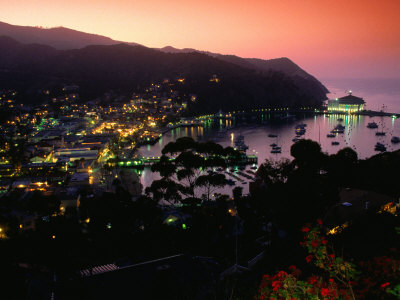
Just 22 miles southwest of Los Angeles, Santa Catalina has a certain Mediterranean flavor. Yachts jostle in a glinting harbor, sorbet-colored homes cascade down the hillside, and the secluded coves are ready-made for romance—including the aptly named Lover’s Cove, east of Avalon.

Santorini, Greece
Sweeping views over a picture-perfect caldera—the result of a volcanic eruption around 1600 B.C.—is just one factor in Santorini’s romantic charm. Gorgeous, striated cliffs and black-sand beaches don’t hurt, either. Head to the famously picturesque village of Oia (book a room at the 18-suite Mystique) with its classic whitewashed, cliff-edge architecture, blue-domed churches, and stone houses overhung with bougainvillea canopies.

Barbuda, Caribbean
If your idea of Eden is unpaved roads, truly deserted beaches, and nary a nightclub, this 68-square-mile island in the Eastern Caribbean is for you. Barbuda features just a handful of high-end hotels, including Coco Point Lodge, on its own 164-acre peninsula fronting glorious pink-sand beaches. Take a boat trip to the Frigate Bird Sanctuary on a lagoon in the island’s northwest and ogle the 5,000 namesake birds that call it home.

Laucala Island, Fiji
The South Pacific fantasy of swaying palm trees and extravagantly lush scenery reaches its fullest expression here. There are just 25 cottages on this privately owned resort, which occupies the entire island, each with a private pool, dining pavilion, and outdoor hot tub and shower. While the resort attracts deep-pocketed travelers, don’t expect glitzy lobbies. The emphasis is on rustic, pared-back luxury; every detail seems crafted to appeal to couples, including the lagoon pool with its man-made “islands” big enough for two.

Pamalican Island, The Philippines
You’ll find only one resort here—Amanpulo, set on its own private island southwest of Manila with just 40 secluded pitched-roof traditional villas, strung along a pristine beach with sand so white it’s blinding. Beachcombers can navigate the entire island on foot in less than two hours, keeping their eyes out for baby sharks, kingfishers, and sea turtles, which lay their eggs here between March and October.


If you like this post just click here Posted By crkota with No comments

Dead Sea Scrolls

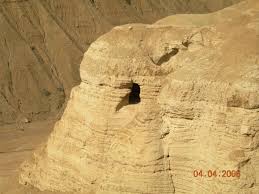
Juma was beginning to get nervous. Some of his goats were climbing too high up the cliffs. He decided to climb the face of the cliff himself to bring them back. Little did Juma realize as he began his climb on that January day in 1947 that those straying goats would eventually involve him in “the greatest archaeological discovery in the twentieth century.” Such thoughts were far from his mind when he saw two small openings to one of the thousands of caves that dot those barren cliffs overlooking the northwestern shore of the Dead Sea.
He threw a rock into one of the openings. The unexpected cracking sound surprised him; what else could be in those remote caves but treasure? He called to his cousins, Khalil and Muhammed, who climbed up and heard the exciting tale. But it was getting late, and the goats had to be gathered. Tomorrow they would return—perhaps their days of following goats would come to an end once the treasure was uncovered!
The youngest of the three, Muhammed, rose the next day before his two fellow “treasure-seekers” and made his way to the cave. The cave floor was covered with debris, including broken pottery. Along the wall stood a number of narrow jars, some with their bowl-shaped covers still in place. Frantically, Muhammed began to explore the inside of each jar, but no treasure of gold was to be found… only a few bundles wrapped in cloth and greenish with age. Returning to his cousins, he related the sad news—no treasure.
No treasure indeed! The scrolls those Bedouin boys removed from that dark cave that day and the days following would come to be recognized as the greatest manuscript treasure ever found—the first seven manuscripts of the Dead Sea Scrolls!
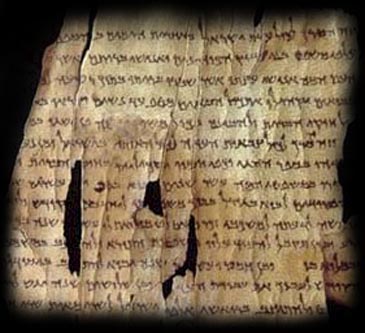
Such was the discovery of a group of manuscripts which were a thousand years older than the then-oldest-known Hebrew texts of the Bible (manuscripts, many of which were written more than 100 years before the birth of Jesus). These manuscripts would excite the archaeological world and provide a team of translators with a gigantic task that even to this day has not been completed.
The story of how those scrolls traveled from the hands of young Bedouin goat herders to be under the scrutinous eyes of international scholars is stranger than fiction. Although all the details of the next few years will probably never be known for sure, this much is clear. After hanging from a pole in a Bedouin tent for a period of time, the seven original scrolls were sold to two separate Arab antiquities dealers in Bethlehem. From there, four were sold (for a small amount) to Athanasius Samuel, Syrian Orthodox Metropolitan at St. Mark's Monastery in the Old City of Jerusalem. Scholars at the American School of Oriental Research, who examined them, were the first to realize their antiquity. John Trever photographed them in detail, and the great archaeologist William F. Albright soon announced that the scrolls were from the period between 200 BC and AD 200. The initial announcements were then made that the oldest manuscripts ever discovered had been found in the Judean desert!
Three of the other original scrolls found by the Bedouin boys were sold to E. L. Sukenik, archaeologist at Hebrew University and father of Yigal Yadin (a general in the Israeli army who later became a famous archaeologist and excavator of Masada and Hazor). It should be noted that the drama of these events was heightened because these were the last days of the British Mandate period in Palestine, and tensions between the Arab and Jewish population were great. This made examination of the scrolls by scholars extremely dangerous.
All of the scrolls finally came together at Hebrew University under another strange set of circumstances. After touring the U.S. with his four scrolls and not being able to find an interested buyer, Metropolitan Samuel placed an ad in the Wall Street Journal. By coincidence (or divine providence?) Yigal Yadin happened to be lecturing in New York and saw the advertisement. Through intermediaries, he was able to purchase these priceless scrolls for around $250,000. In February of 1955, the Prime Minister of Israel announced that the State of Israel had purchased the scrolls, and all seven (including the three purchased earlier by Professor Sukenik) were to be housed in a special museum at Hebrew University named the Shrine of the Book, where they can be seen today.
Needless to say, the initial announcement about the scrolls prompted feverish searches in the area of the original discoveries. An official archaeological expedition was begun in 1949 which eventually resulted in the discovery of ten additional caves in the surrounding area also containing scrolls. The archaeologists then directed their attention to a small ruin nearby called "Khirbet (ruins of) Qumran," which had been thought of as the remains of an old Roman fortress. After six seasons of intensive excavation, the scholars were sure beyond any reasonable doubt that the scrolls found their origin in this community which flourished between 125 BC and AD 68. The scrolls had been stored in haste in the caves as the community fled the encroaching Roman army, which was in Judea to put down the Jewish Revolt of AD 66-70.
The ruins of Qumran, which can be visited today, revealed that a substantial group of Jewish ascetics inhabited this community. Storehouses, aqueducts, ritual baths and an assembly hall were all uncovered. One of the most interesting rooms uncovered was a scriptorium, identified by two ink wells discovered there along with some benches for scribes. It was in this room that many, if not all, of the discovered manuscripts were copied.

Description of the Scrolls

As soon as the announcement of the scrolls' discovery was made, the scholarly debates about their origin and significance began. The debates increased when the amazing contents of the scrolls were successively revealed.
The seven original scrolls, from what came to be called “Cave One,” comprised the following:
  1. a well-preserved copy of the entire prophecy of Isaiah—the oldest copy of an Old Testament book ever to be discovered
  2. another fragmentary scroll of Isaiah
  3. a commentary on the first two chapters of Habakkuk—the commentator explained the book allegorically interms of the Qumran brotherhood
  4. the “Manual of Discipline” or “Community Rule”—the most important source of information about the religious sect at Qumran—it described the requirements for those aspiring to join the brotherhood
  5. the “Thanksgiving Hymns,” a collection of devotional “psalms” of thanksgiving and praise to God
  6. an Aramaic paraphrase of the Book of Genesis
  7. the “Rule of War” which dealt with the battle between the “Sons of Light” (the men of Qumran) and the “Sons of Darkness” (the Romans?) yet to take place in the “last days,” which days the men of Qumran believed were about to arrive.
Those seven original scrolls were just the beginning. Over six hundred scrolls and thousands of fragments have been discovered in the 11 caves of the Qumran area. Fragments of every Biblical book except Esther have been found, as well as many other non-Biblical texts.
One of the most fascinating of the finds was a copper scroll which had to becut in strips to be opened and which contained a list of 60 treasures located in various parts of Judea (none of which have been found)! Another scroll, which Israeli archaeologists recovered in 1967 underneath the floor of a Bethlehem antiquities dealer, describes in detail the community's view of an elaborate Temple ritual. This has been appropriately called the “Temple Scroll.”
The contents of the Dead Sea Scrolls indicate that their authors were a group of priests and laymen pursuing a communal life of strict dedication to God. Their leader was called the “Righteous Teacher.” They viewed themselves as the only true elect of Israel—they alone were faithful to the Law.
They opposed the “Wicked Priest”—the Jewish High Priest in Jerusalem who represented the establishment, and who had persecuted them in some way. This wicked priest was probably one of the Maccabean rulers who had illegitimately assumed the high priesthood between 150-140 BC. Most scholars have identified the Qumran brotherhood with the Essenes, a Jewish sect of Jesus' day described by Josephus and Philo.
Whoever the men of Qumran were, their writings provide us with a marvelous background picture of one aspect of the religious world into which Jesus came. Some have sought to draw parallels between figures in the scrolls and John the Baptist or Jesus, but an objective examination of such parallels reveals that the differences are greater than the similarities. Any contact of Jesus with Qumran is entirely speculative and most improbable. The suggestion that John the Baptist may have spent some time with the Qumran community is possible, since the Gospels tell us that he spent considerable time in the wilderness near the area where the Qumran community is located (Mt. 3:1-3; Mk. 1:4; Lk. 1:80; 3:2-3). John's message, however, differed markedly from that of the Qumran brotherhood. The only real common point was that they both taught that the "kingdom of God" was coming.
One of the most important contributions of the Dead Sea Scrolls is the numerous Biblical manuscripts which have been discovered. Until those discoveries at Qumran, the oldest manuscripts of the Hebrew Scriptures were copies from the 9th and 10th centuries AD by a group of Jewish scribes called the Massoretes. Now we have manuscripts around a thousand years older than those. The amazing truth is that these manuscripts are almost identical! Here is a strong example of the tender care which the Jewish scribes down through the centuries took in an effort to accurately copy the sacred Scriptures. We can have confidence that our Old Testament Scriptures faithfully represent the words given to Moses, David and the prophets.

Doctrine of the Scrolls

The men of Qumran fervently believed in a doctrine of “last things.” They had fled to the desert and were readying themselves for the imminent judgment, when their enemies would be vanquished and they, God's elect, would be given final victory in accordance with the predictions of the prophets. It was in connection with these end-time events that one of the most fascinating teachings of the sect emerges. The messianic hope loomed large in the thought of the brotherhood. As a matter of fact, evidence shows that they actually believed in three messiahs—one a prophet, another a priest and the third a king or prince.
In the document mentioned earlier called the “Manual of Discipline” or the "Rule of the Community," it is laid down that the faithful should continue to live under the rule "until the coming of a prophet and the anointed ones [messiahs] of Aaron and Israel" (column 9, line 11). These three figures would appear to usher in the age for which the community was making preparation.
In another document found in Cave Four and referred to as the “Testimonia,” a number of Old Testament passages are brought together which formed the basis for their messianic expectations. The first is the citation from Deuteronomy 18:18-19 where God says to Moses: "I will raise them up a Prophet from among their brethren, like unto thee." Next comes a quotation from Numbers 24:15-17, where Balaam foresees the rise of a princely conqueror: "a Scepter shall rise out of Israel, and shall smite the corners of Moab," etc. The third passage is the blessing pronounced by Moses upon the tribe of Levi (the priestly tribe) in Deuteronomy 33:8-11. The way in which these three quotations are brought together suggests that the writer looked forward to the advent of a great prophet, a great prince and a great priest.
There were three individuals in the Old Testament writings that were referred to as "my anointed ones"—the prophet, the priest and the king (refer to Ex. 29:29; 1 Sam. 16:13, 24:6; 1 Kg. 19:16; Ps. 105:15). Each of these was consecrated to his work by an anointing with oil. The Hebrew word for "anointed" is meshiach, from which we get the word Messiah.
The marvelous truth of the New Testament doctrine of the Messiah is that each of these three offices found fulfillment in the person and work of Jesus of Nazareth! The people were amazed at His feeding of the multitude and said, "This is of a truth that prophet that should come into the world" (Jn. 6:14; also Jn. 7:40; Acts 3:22, 7:37). Jesus also was a priest, not from the order of Levi but from the order of Melchizedek (Ps. 110:4; Heb. 7), who offered Himself as a sacrifice and appears for us in the presence of His Father (Heb. 9:24-26; 10:11-12). Also, Jesus was announced as the One who will receive "the throne of his father, David. And he shall reign over the house of Jacob forever; and of his kingdom there shall be no end" (Lk. 1:32-33). He will be acclaimed "KING OF KINGS, AND LORD OF LORDS" (Rev. 19:16).
Thus, we have found an interesting point of contact between Qumran and Christianity—a point of contact which is also a point of cleavage. The Qumran community and the early Christians agreed that in the days of the fulfillment of Old Testament prophecies there would arise a great prophet, a great priest and a great king. But these three figures remained distinct in Qumran expectation, whereas the New Testament saw them unified in the person of Jesus of Nazareth.
One more manuscript that has come to light in recent years provides a fascinating background to the New Testament messianic hope. It has been reconstructed from twelve small fragments, furnishing less than two columns of writing; but this much can be ascertained from its brief contents. It is a prediction of the birth of a Wonderful Child, possibly drawing on Isaiah 9:6-7: "For unto us a child is born, unto us a son is given... and his name shall be called Wonderful." This child will bear special marks on His body and will be distinguished by wisdom and intelligence. He will be able to probe the secrets of all living creatures, and He will inaugurate the new age for which the faithful fervently awaited.
Is it not striking that soon after this manuscript was composed, a child wa sborn who fulfilled the hopes of Israel and inaugurated a new age? Although the men of Qumran were mistaken in the details of their messiah, they did expect one whose general characteristics were strikingly illustrated by Jesus of Nazareth, the Son of God and Messiah. It is not known if some early Christian brought the message of Jesus to this wilderness community. We are left only to speculate on how they would have responded to the Wonderful Child born in Bethlehem who was the Prophet, Priest and King of Israel.

If you like this post just click here Posted By crkota with No comments

Eyewitness Accounts of Megalodon sighting


A sharp, coppery emptiness rumbled deep within the creature's gut. Two full moons had come and gone since it had last fed, and its need was now overriding. Desperate. Before it, an invisible cone of fear swept the warm, shallow sea clean of life. Shoals of hake and tilefish panicked at its coming, scattering like handfuls of flung metallic spears. At a length of 50 feet (15 metres) and a mass of over 52 tons (47 tonnes), it would take more than a mere morsel to satisfy the megalodon. The enormous shark needed food - big food. A marlin circled lazily to the Megalodon's left, its barred ultramarine flanks glittering in the flickering shafts of late afternoon sunlight. Capable of mind-stuttering bursts of speed, it was too hard to catch for the shark to bother with. But still Megalodon's hunger burned. Skulking silently along the bottom, the megalodon caught a glimpse of a whale rising gently to the surface to ventilate its lungs. It was a cetothere, slow-moving and about 30 feet (10 metres) long: perfect. But the whale would only be vulnerable for a few moments, as it recovered from its most recent dive. As the whale drew in fresh air to replenish its spent supply, megalodon continued its stalk. Closer . . . closer . . . NOW!! The shark pumped its tail powerfully from side-to-side, accelerating rapidly to close the distance between it and the fuel its cells so urgently needed. The Megalodon's jaws gaped wide, revealing triangular, serrated teeth the size of a man's hand. Oxygen-bearing water pounded through its gills exhilaratingly. The Megalodon's upper jaw, slung loosely under its skull like that of other sharks, protruded forward and down: reaching, straining in anticipation of sweet, warm flesh . . .
Less than 5% of the deep-sea has been explored, and even less than that sampled biologically. Yet we know that sharks live at least as deep as 12,000 feet (3,660 metres) and Sperm Whales (Physeter macrocephalus) are believed to dive to 10,000 feet (3,050 metres) in search of squid. If there's enough food down there for 60-foot (18-metre) whales, there is probably enough to support Megalodon.


-In the year 1918 I recorded the sensation that had been caused among the "outside" crayfish men at Port Stephens, when, for several days, they refused to go to sea to their regular fishing grounds in the vicinity of Broughton Island. The men had been at work on the fishing grounds---which lie in deep water---when an immense shark of almost unbelievable proportions put in an appearance, lifting pot after pot containing many crayfishes, and taking, as the men said, "pots, mooring lines and all". These crayfish pots, it should be mentioned, were about 3 feet 6 inches [1.06 m] in diameter and frequently contained from two to three dozen good-sized crayfish each weighing several pounds. The men were all unanimous that this shark was something the like of which they had never dreamed of. In company with the local Fisheries Inspector I questioned many of the men very closely and they all agreed as to the gigantic stature of the beast. But the lengths they gave were, on the whole, absurd. I mention them, however, as a indication of the state of mind which this unusual giant had thrown them into. And bear in mind that these were men who were used to the sea and all sorts of weather, and all sorts of sharks as well. One of the crew said the shark was "three hundred feet [90 m] long at least"! Others said it was as long as the wharf on which we stood---about 115 feet [35 m]! They affirmed that the water "boiled" over a large space when the fish swam past. They were all familiar with whales, which they had often seen passing at sea, but this was a vast shark. They had seen its terrible head which was "at least as long as the roof on the wharf shed at Nelson's Bay." Impossible, of course! But these were prosaic and rather stolid men, not given to 'fish stories' nor even to talking about their catches. Further, they knew that the person they were talking to (myself) had heard all the fish stories years before! One of the things that impressed me was that they all agreed as to the ghostly whitish color of the vast fish. The local Fisheries Inspector of the time, Mr Paton, agreed with me that it must have been something really gigantic to put these experienced men into such a state of fear and panic.
 
-One eyewitness accounts interpreted as being of Megalodon are put forward by Cartmell (1978). His first piece of evidence is sonar trackings by “one of the new breed of underwater exploratory vehicles” of an unidentifiable object about 100 ft (30 m) long that was travelling faster than any submarine. The absurdity of this account---which supposedly serves as evidence for C. megalodon survival---will not be commented upon. Cartmell also mentions another eyewitness account of a giant shark:
In the 1960’s along the outer edge of Australia’s Great Barrier Reef, an 85 foot [26 m] ship experienced engine trouble which forced it to weigh anchor for repairs. Although the men subsequently refused to openly report what they had seen for fear of public ridicule, the captain and his crew later told friends of sighting an immense shark as it moved slowly past their ship. Whitish in color, they were awed by its size. It was as long if not longer than their boat! Experienced men of the sea, they too were certain the creature was not a whale.

 -Possible Megalodon in Mariana trench 

The deepest portion of the Pacific Ocean, the Challenger Deep, is located in the Mariana Trench in the western Pacific. Recently, Japanese researchers have conducted an interesting experiment in the Suruga Bay, not far from the Mariana Trench, the deepest spot in the World Ocean. The researchers put a container with some smelly bait on the bay bottom. A special video camera was attached to the wall of the container. The researchers peered into monitors to see what would happen with the container and the bait. The smell of the bait attracted a shoal of deep-water sharks. But then the researchers saw something incredible that left them speechless. Suddenly the sharks scattered in all directions and researchers saw an incredibly huge monster on the screens of their monitors. The giant slowly soared before the video camera at a depth of about 1.5 kilometers. The length of the sea Goliath was over 60 meters (more than 180 feet). It was not clear what the giant was in fact.Researchers failed to answer the question, just made conjectures concerning what the creature may be. They said that might be a sleeping shark, the largest shark . Even now people know just few facts about these sharks. They have been hiding in the dark ocean deeps for millions of years. People have never seen live sleeping sharks as well as giant squids. Only once, in 1964, a bulk of a dead sleeping shark was cast ashore in Indonesia; it was just a very young shark judging by its size of 26 meters. ..PRAVDA 9/20/03 "Scientists still do not know what they saw, registered and filmed and not a single frame has been released. If it was a giant shark Megalodon is a good candidate, even though this monster is thought to have died out 170 million years ago; see our features Megalodon the Monster Shark and New Evidence for Megalodon. If it was a classical sea serpent it´s easy to understand why the Japanese scientist´s are cautious and would like to analyze the video footage very careful before releasing it to the world."


An alleged footage of this event:


-Another sighting took place in 1933, again off the coast of Rangiroa. Aboard the S.S. Manganui, Grey and his son Loren were returning to San Francisco after a fishing trip to Tahiti. One evening at about 5:00 p.m., Loren was at the rail when he saw a small flock of spiralling sea gulls and, near by, an area of yellow water :
At first I thought it was a whale, but when the great brown tail rose in the ship’s wake as the fish moved ponderously away from the liner, I knew immediately that it was a monstrous shark. The huge round head appeared to be at least 10 to 12 feet across if not more ... It was my belief that this huge, yellowish, barnacled creature must have been at least 40 or 50 feet long. He was not a whale shark: the whale shark has a distinctive white purplish green appearance with large brown spots and much narrower head. So what was he---perhaps a true prehistoric monster of the deep?

What we had seen was something [that] no ichthyologist had ever dreamed existed. The largest known specimen of this type of shark, generally known as a sand shark or black-tipped shark, had hardly been known to exceed a length of about 15 feet.
Despite Loren Grey’s assertions that what he saw was not a whale shark (mirroring his father’s reaction to his own sighting), it is most likely that that is exactly what is was. Grey’s description of a whale shark is completely erroneous: whale sharks are a dark grey, greenish grey or reddish colour above, with many white or yellowish spots and transverse stripes, and are yellowish or white on the underside (Castro 1983). As mentioned previously, they also have a very wide, squarish, yet slightly rounded head. All of these traits fit well with Grey’s description.


 If you want to know more about this there is an interesting book about Megalodon:

If you like this post just click here Posted By crkota with 1 comment

Types of Dragons


Amphiptere
Description: Winged or flying serpents
Famous: Quetzacoatl, the Dragon of Henham (169, Essex), many monsters in the mythology of ancient egypt : Aapep, Mertseger, Buto, Nekhbet


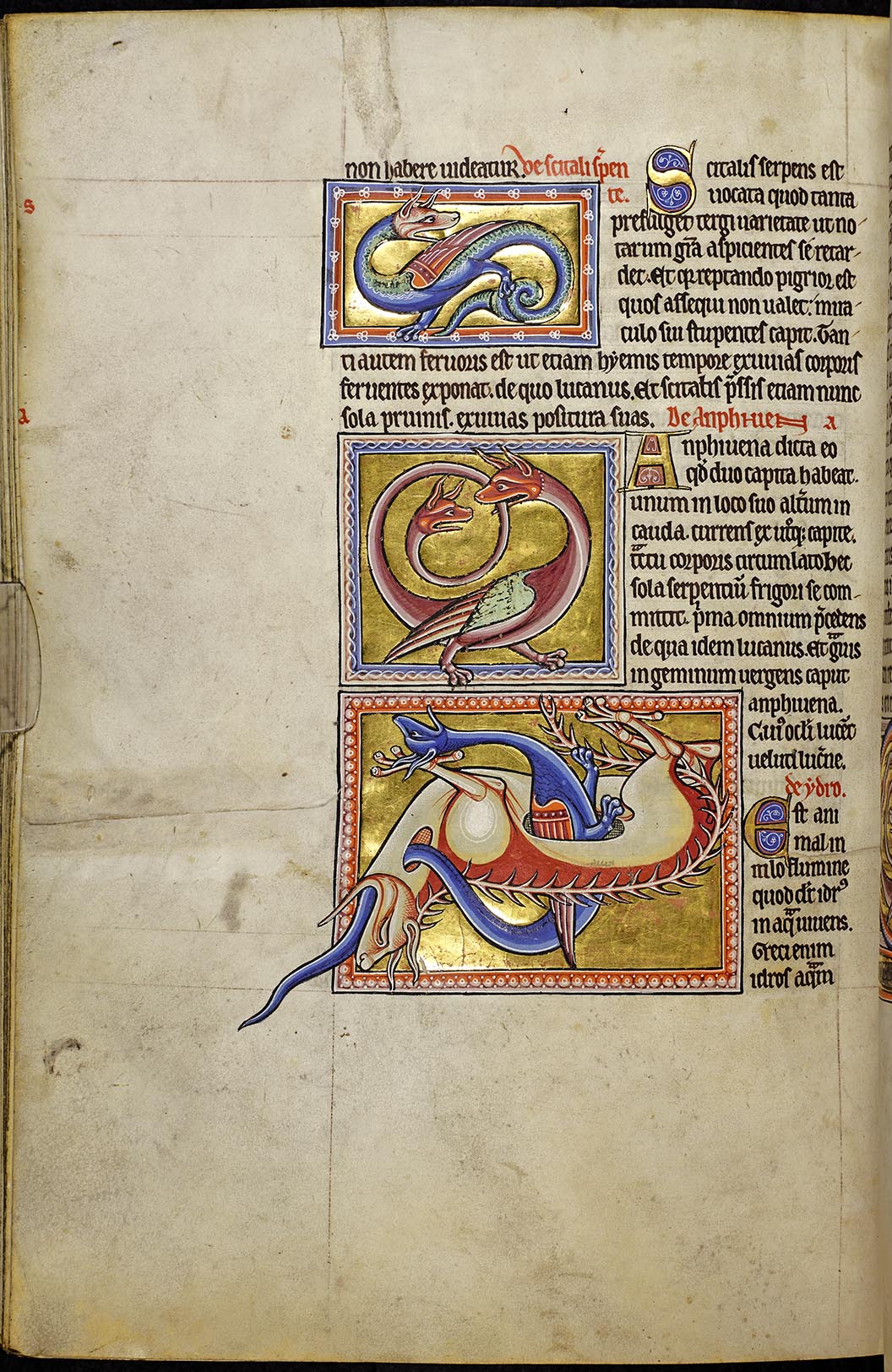
Amphisbaena
Description:double-headed serpent-dragons with heads at each end of its body. Its name means 'goes both ways' in Greek as it could reportedly stick one head inside the mouth of the other, and roll to where it wanted to go. Some pictures of this creature depict it as having feet, others just as a snake.It was said to be a very evil creature. Pliny recorded medicinal properties of the beast. Wearing a live amphisbæna will protect pregnant women, and wearing a dead one is a remedy of rheumatism.


Dragonet
Element : Earth
Description : They are small dragons less than 1.5 m high but very fierce and hostile to humans. Famous: the dragons of Wilser who lived on the mount Pilate (Switzerland) had poisoned blood and exhaled fire.


Firedrake
Element : Earth
Origin: Germany, Gaule (France)
Description: A drake is a dragon with only legs and no wings. FireDrakes have the breath of flame, and are usually reddish in color. In Europe many cities were named after this dragon: Drakeford, Drakeshill, Draguignan,...
Lore: They often live in caves and guard great treasure. They breath fire to defend themselves. Famous: Wiglaf, the firedrake killed by Beowulf


Hydra
Origin: Greece Description: many headed dragon who either have wings, or wingless. When one head is cut off, two more grow from the spurting blood.
Famous : the Hydra of Lernea, the Beast of the Apocalypse


Icedrake
Element : Water
Description: A drake is a dragon with only legs and no wings. Icedrakes exhaled snow and hail and are usually white or light bluish in color. These types of dragons do not fly, they look like large lizards being about 5-20 m long.


Naga
There are no trace of dragons as made up of different parts of animals in India. The closest creature is the Naga which inherited of many characteristics of the dragon.
Description: pseudo-dragons who are usually portrayed as having a human head, serpentine body, and no wings.
Origin: The word Naga is rooted in Sanskrit and means "Serpent". It is one of a handful of rare words surviving the loss of the first universal language. Even in Mexico, we find the "Naga" which becomes "Nagal."
Powers: Nagas were patrons of water and clouds, but could cause flooding or drought if disturbed. In some stories, the naga can shape-change at will from human to snake form Symbol: In the Esoteric Tradition it is synonymous for Adepts, or Initiates. In India and Egypt, and even in Central and South America, the Naga stands for one who is wise. Nagarjuna of India, for example, is shown with an aura, or halo, of seven serpents which is an indication of a very high degree of Initiation. Nagarjuna are called in Tibetan, Lu-trub. The symbolism of the seven serpents, usually cobras, are also on Masonic aprons of certain systems in the Buddhistic ruins of Cambodia (Ankhor) and Ceylon. In China, the Naga is given the form of the Dragon and has a direct association with the Emperor and is known as the "Son of Heaven" while in Egypt the same association is termed "King-Initiate". The Chinese are said to have originated with the Serpent demi-gods and even to speak their language, Naga-Krita. In the Western traditions we find the same ubiquity for the Naga, or Serpent. One simple example is the Ancient Greek Goddess, Athena. She is known as a warrior Goddess as well as the Goddess of Wisdom; her symbol being the Serpent as displayed on her personal shield. An apocryphal tradition says that Apollonius of Tyana, while on a visit to India, was taught by the "Nagas" of Kashmir. (See The Life of Apollonius, by Philostratos.) The Serpent's reputation for positive medicinal and/or life-preserving qualities is still present through seen the employment of the Caduceus.
Oriental Dragons
Element : Water
Powers: Some of the worst floods in Asia's History were caused when a mortal has upset a dragon. Dragons were essentialy linked to the water element, influencing the weather and the water courses. According to Chinese mythology, a dragon has to spend 1000 years under the sea, 1000 years in the mountains and 1000 years among men before turning into a real dragon. Before that he is a small serpent prisoner of a stone, called a “serpent’s egg”. After 3000 years, the dragon escape and take his adult form, the stone was known to spill a magic liquid called “inky blood”.
Friend/Foe : In the Eastern world the dragon has a rather different significance than in the West. He is essentially benevolent, son of heaven, and controls the watery elements of the universe.In many cases the dragon is combined with the phoenix to symbolize long life and prosperity. It is also combined with the tiger to represent heaven and earth or inyo (Yin and Yang).
Description : Having sinuous serpentine bodies and four legs, eastern dragons do not usually breath fire, nor do they fly. According to Wang Fu (Han 206 BC-220 AC)dragons are made up of many different types of animals of the Earth: the body of a snake, scales of a carp, head of a camel, horns of a deer, the eyes of a hare, ears like a bull, a neck like an iguana, belly of a frog, paws like a tigers, and claws like an eagle. A lion-type mane decorates its neck, its chin, and each elbow. They also carry two antler-like horns on their wide-mouthed head, and two long whiskers spread out from their snout. They are depicts in many colors like blue, black, white, red, or yellow. Oriental dragons are usually shown with a pearl in their mouth, under their chin, or in their claws. This is apparently where the dragon gets its power, and how it ascends to heaven. The male dragon holds a war club in its tail while the female dragon holds a sensu or fan in its tail.
Types
There are many different kinds of dragons. Some live in the air, some live in the sea, and some live underground. The legends of China include a white lunar (moon) dragon. Others include the the Spiritual, The Dragon of Hidden Treasures, the Winged, the Horned, the Coiling, and the Yellow. The chinese have a dragon to help them for each circumstance of their life. In China dragons are known as Lung.Yu-Lung which looks like a fish give success to exams. Eastern dragons can be classified according to the number of claws they have. Most five clawed dragons are Chinese. Three clawed dragons are Japanese. Four clawed dragons are Chinese, Indonesian or Korean.
Ourobouros
Aka: oroborus, uroboros, and oureboros.
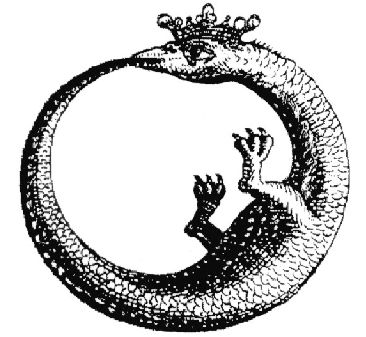
Description: a serpent whose end is his beginning as he endlessly eats his own tail.
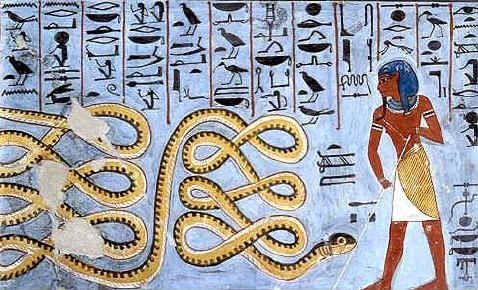
Origin: The Serpent biting its own tail is first seen as early as 1600 years BC in Egypt. From there it moved to the Phonecians and then to the Greeks, who called it the Ouroboros, which means devouring its tail Famous: The serpent biting its tail is found in other mythologies as well. In Norse mythology Jörmungandr circles the entire world whith his huge body., in Hindu mythology the snake circles the tortoise which supports the four elephants that carry the world. Symbol: the serpent biting, devouring, eating its own tail symbolises the cyclic Nature of the Universe: creation out of destruction, Life out of Death. The ouroboros eats its own tail to sustain its life, in an eternal cycle of renewal. It is also an emblem of immortality. Its endless representation with its tail in its mouth (Ouroboros), and the constant renewal of its skin and vigor, enliven the symbols of continued youth and eternity. Alchemically, the ouroboros is also used as a purifying glyph. He keeps the cosmic waters under control, and is symbolic of the cyclical nature of alchemical work. He is the basilisk, the alchemical serpent.
Western Dragons
Element : Earth and Water
Description: The Western type of dragon has been variously described. He appears to be created from parts of various creatures, having eagle's feet, two bat-like wings, lion's forelimbs, reptile’s head, fish's scales, antelope's horns and a serpentine form of spade tail, which occasionally extended to the head.He can be of any color and some species can even change the color of their skin just like a chameleon. They usually breath fire but this is not a general trait.
Powers: Those dragons usually have huge hoards of gold and jewels hidden in their lairs. They are known to live more than 300 years, some western dragons are even immortal.
Friend/Foe: They do not eat too often and can live on a sheep or ox once a month. They are usually portrayed as evil, mean, and bloodthirsty which is a consequence of the demonization exerced by the Church.
Famous: The end of the dragon came with Christianity as the Church declares them as enemies and send hords of knights to struggle against them. As a result, most dragons have been destroyed (and even more knights have been burned).

Magic: Eating a dragons' heart will give the the power of understanding the language of animals, eating the dragons' tongue enables to win any argument, and rubbing the dragons' blood on skin will protect against stabs


Worm
Description: These are dragons which have neither legs nor wings
Origin: Worms are known to be the first incarnations of dragons. They are linked to water and are omnipresent in most primitive cultures (Australia, Africa, Amazonia)
Famous: the Lambton Worm.
Lore : forests and wells and any dark place near water


Wyvern
Aka: Wyver, Lindworm, Lindorm, Wouive, Vouivre
Element : Earth
Description: two-legged dragon with two wings, a serpent’s head and the claws of an eagle.In modern images, they may have claws on the wings and a sting filled with poison on the end of its tail. The French Wyvern known as a Vouivre or Wouive, is portrayed with the head and upper body of a voluptuous woman with a ruby or garnet set between her eyes that help her to find her way through the Underworld.
Origin: from the Old French wyvere which means both viper and ‘life’. They were also very popular mountains of central europe and in Sweden
Friend/Foe : Wyvern are frequent in heraldry and are considered a sign of strength to those who bear the symbol. Wouive is the good ‘Genius’ who hovers protectively over the countryside and masters the underlying currents of the earth. She is ‘the spirit that breathes or inspires.’ The ancients represented these currents, that today we term cosmic or magnetic, by winged serpents. Neverthelessthe Wyvern appears in some western folk tales as a malign and violent predator with a fierce head, bat’s wings and a tail that sometimes has an extra scorpion-like head on its end. The life-giving aspect of the Wyvern is inverted in favour of death as she takes life. The Wouive’s ‘Breath of Life’ has been reversed, for the Wyvern is said to have poisonous and corrupt breath. These dragons symbolise envy, war, pestilence, and viciousness.
Famous: Marco Polo met and described Lindworms while crossing Central Asia. They were quick and mighty enough to take down a man on a galloping horse.

If you like this post just click here Posted By crkota with No comments

Dragons Hystorycal Stories


The Jabberwocky, from Lewis Carroll's Through the Looking-Glass and What Alice Found There, 1872.

Although the time that dragons first appeared in myths isn't known for sure, they can be traced back as far as approximately 4000 B.C. Dragons are said to have been able to live almost anywhere, depending on the type of dragon mentioned. Their habitats range from the center of the earth to the middle of the ocean. They could also be found in caves, fire, or anywhere dark and damp.
Stories of dragons appear all throughout history and almost every culture has their own idea about dragons. Some reasons for this could be the finding of dinosaur fossils. Dragons could be used to describe the indescribable bones of unknown creatures. There are stories about dragons in every part of the world, with the exception of Antartica. Even though there are no people in Antartica, which in that way would seem to make it attractive to dragons, the climate proposes a problem for these creatures who like fire or live in water, but not ice water.
One type of dragon, or sea monster, was feared back in the time of Christopher Columbus. During this time when the world was thought to be flat, these dragons were said to be at the edge of earth, waiting to eat any one who dared to sail that far into the ocean. This story kept many people from exploring farther into the world. Maps were even made marking the place where these dragons lived. At the edge of the map the words "Here Be Dragons" was almost always printed.


A knight and a dragon.

Dragons have also appeared in stories that go back to the time of the gods in mythology. The story of Perseus and the Dragon of Posdeidon tells of a vain queen who almost sacrificed her daughter to the dragon, had it not been for Perseus.
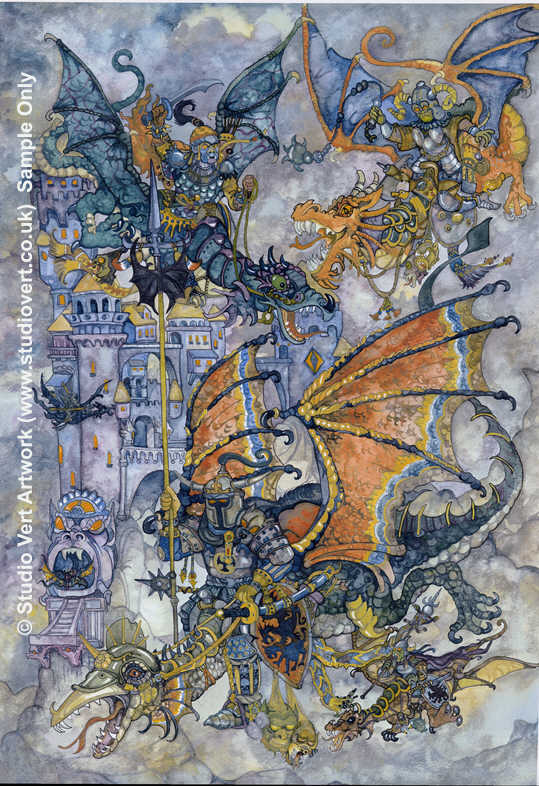
Dragons appear most in fairy tales and myths. In most cases the dragon is the keeper of some treasure, either gold and precious jewels or a maiden in despair. A knight in these stories must come to rescue the girl, or to retrieve the riches. To do this he must slay the dragon.
Almost all young children have heard stories of dragons. A story that arose from the Middle Ages is about a knight, later called St. George, who rescued a princess from a dragon and in return was able to baptize the Pagan people to Christianity. The story says that every year a maiden was sacrificed to this dragon. One year when the princess was going to be sacrificed, St. George decided to rescue her. Using his sword, Ascalon, he was able to stab the dragon and later slay him. This may be one of the most popular heroic stories involving the death of dragons, although there are many. The story of St. George and the Dragon has been told for centuries and the event was even painted by the great artist Raphael.


A norseman fights off a sea dragon.

Like St. George and the Dragon, many other stories have been told about dragons and the heroes who kill them. One story like this comes from Norway. The king left his daughter in the castle while he went away on a long trip. He left her a tiny dragon to be her guardian. The princess was skeptical of the tiny creatures, fearing that it could not protect her. However, the dragon soon grew into a large monster. He soon became too good of a guardian for the princess when he grew large enough to wrap his body all around the castle and not let anyone in or out of it. When the king returned home, even he was not permitted inside the castle. The only thing to do was to kill this dragon, so the king offered his the marriage of his daughter to anyone who could kill this dragon. No man in Norway was capable, but a man in Sweden finally killed the beast. As his reward he married the princess and they returned to Sweden together.
Another story is about another young man who fought a dragon for the reward of bringing the king's daughter to his master for marriage. In this story Tristan is tricked by another man who wants the princess for his own wife. In the end Tristan cut off the dragon's tongue as proof of his accomplishment and the lies of the other man were discovered.
During the times of dragons in England, anyone who killed a dragon was awarded knighthood. In ancient Rome, dragons were thought to hold the mysteries of the earth. Romans looked to dragons as a source of knowledge and used them as symbols of strength for their military. They used two forms of dragons, one which was used for heroism, to protect them, and the other, a fearsome dragon, used as a threath.
A wizard fighting a wyrm on a cliff.
Other tales about dragons are more about their toes then the dragons themselves. How many toes a dragon has is quiet significant. Many different kinds of dragons are said to have 3 toes. The 4 toed dragons are said to be the earth dragons. But the 5 toed dragons are the most respected of all. Only a king or a high noble had the privilege of wearing a picture of the 5 toed dragon. In ancient times if a peasant was seen wearing the symbol of the 5 toed dragon, he would immediately be put to death.
Dragons seem to have come from exaggerated myths about huge snakes, lizards or other reptiles. One type of dragon is actually called the Wyrm, and has a very snake-like form, with a dragon head. Another smaller form of dragon is called a dragonlet. These dragons are also venomous and can be deadly. In the story The Dragonlet of St. Pilatus, only man with a bad temper and skills with a sword was able to defeat this monster that was only the height of the hero. In almost every culture and all throughout history there are stories of these magical creatures called dragons.

If you like this post just click here Posted By crkota with 2 comments

Mysterious creature washes up on South Carolina shore

Something strange washed ashore on Folly Beach in South Carolina this past weekend. The beast had some wondering if it was some sort of new species. It could have been America’s answer to the Loch Ness Monster...
The corpse of a large, beady-eyed and scaly creature washed ashore on Folly Beach, much to the shock of locals. 
But, be not afraid. According to AOL's Pawnation, the freakishly large creature may look alien, but it is harmless. A veterinarian from a South Carolina aquarium identified the fish as a Atlantic sturgeon.
The species can grow to be as big as 15 feet long and 800 pounds, but are usually around 10 feet long and 300 pounds. Reports say that these alien-like creature is actually harmless.
Their bodies are covered in bony plates called scutes rather then scales, and they have barbels on their faces that help them locate prey, characteristics which give them their bizarre appearance.
But this may be the last time residents in the area see a fish to this scale as sturgeons, which have been swimming our seas for 100 million years, are at risk.
Sturgeon populations are being hit hard by commercial fishing, with several species making the endangered list, as they are a popular target for caviar.


If you like this post just click here Posted By crkota with No comments

UFO Making Crop Circle Footage near Oliver’s Castle, Wiltshire, UK

On 11 August 1996, a student John Wabey recorded a short video that he claimed to have shot that morning during camping in south England at Oliver's Castle, a fort in Wiltshire. It showed a ‘snowflake’ design forming while balls of light circled overhead. Four swiftly moving light balls are clearly visible, circling above the formating crop circle.

 This clip has been taken from a detailed anaylsis of the footage. There are many features of this video which point towards its authenticity. The 1st is the fact that the camera is handheld, the luminations path are easily plottable relative to background. 2nd on a frame by frame analysis we can see that the balls are in fact constantly changing shape. 3rd, the 2nd set of lights comes into the shot from behind the tree next to the hedges, and this detail would not be picked up by regular televisions. 4th is the formation itself, which was not there on the night of the 10th when John Wabey was asking if anyone wanted to join him on his UFO hunt on the hill at the Barge Inn Pub.


Most professional videolaboratories, where the tape was examined, certify that the film is "clean" and that it is unlikely that the video was edited with computer. Computer animators in 2006 couldn't make anything that even closely resembles the authentic look of this footage, shot 10 years previously, when Windows 95 was the most exciting piece of software on the planet. It is time that the skeptical community put aside their disbelief that this phenomenon is genuinely mysterious.

The footage provoked bitter controversy among crop-circle researchers. One group insists that the crop design is man-made and the video a fake, and claims to have obtained a confession from the person who made it, while others still think that both are genuine.
There is enough evidence to show that it is impossible for humans to mimic the complexity, beauty, accuracy, geometry, scale and physical changes to the plants and soil. Who or what are these balls of light? Are they native to Earth and we simply don't see them? How can they appear to move at 100 feet a second in mid air? How can they focus microwaves so accurately to create spirals of this and greater complexity? And the big one... WHY? Why do they send us these cryptic geometric puzzles? And what can we as a species learn from them?

If you like this post just click here Posted By crkota with No comments

Titanoboa - the largest snake ever lived

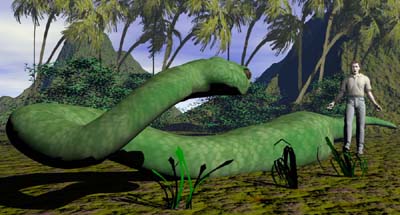
The largest snake the world has ever known — as long as a school bus and as heavy as a small car — ruled tropical ecosystems only 6 million years after the demise of the fearsome Tyrannosaurus Rex, according to a new discovery published in the journal Nature.

Partial skeletons of a new giant, boa constrictor-like snake named “Titanoboa” found in Colombia by an international team of scientists and now at the University of Florida are estimated to be 42 to 45 feet long, the length of the T-Rex “Sue” displayed at Chicago’s Field Museum, said Jonathan Bloch, a UF vertebrate paleontologist who co-led the expedition with Carlos Jaramillo, a paleobotanist from the Smithsonian Tropical Research Institute in Panama.

Researchers say the extinct snake was even larger than the wildest dreams of directors of modern horror movies.

“Truly enormous snakes really spark people’s imagination, but reality has exceeded the fantasies of Hollywood,” said Bloch, who is studying the snake at the Florida Museum of Natural History on the UF campus. “The snake that tried to eat Jennifer Lopez in the movie ‘Anaconda’ is not as big as the one we found.”

Jason Head, a paleontologist at the University of Toronto in Mississauga and the paper’s senior author, described it this way: “The snake’s body was so wide that if it were moving down the hall and decided to come into my office to eat me, it would literally have to squeeze through the door.”

Besides tipping the scales at an estimated 1.25 tons, the snake lived during the Paleocene Epoch, a 10-million-year period immediately following the extinction of the dinosaurs 65 million years ago, Bloch said.

The scientists also found many skeletons of giant turtles and extinct primitive crocodile relatives that likely were eaten by the snake, he said. “Prior to our work, there had been no fossil vertebrates found between 65 million and 55 million years ago in tropical South America,leaving us with a very poor understanding of what life was like in the northern Neotropics,” he said. “Now we have a window into the time just after the dinosaurs went extinct and can actually see what the animals replacing them were like.”

Size does matter because the snake’s gigantic dimensions are a sign that temperatures along the equator were once much hotter. That is because snakes and other cold-blooded animals are limited in body size by the ambient temperature of where they live, Bloch said.

“If you look at cold-blooded animals and their distribution on the planet today, the large ones are in the tropics, where it’s hottest, and they become smaller the farther away they are from the equator,” he said.

Based on the snake’s size, the team was able to calculate that the mean annual temperature at equatorial South America 60 million years ago would have been about 91 degrees Fahrenheit, about 10 degrees warmer than today, Bloch said.

The presence of outsized snakes and turtles shows that even 60 million years ago the foundations of the modern Amazonian tropical ecosystem were in place, he said.

Fossil hunting is usually difficult in the forest-covered tropics because of the lack of exposed rock, Bloch said. But excavations in the Cerrejon Coal Mine in Northern Colombia exposed the rock and offered an unparalleled opportunity for discovery, he said.

After the team brought the fossils to the Florida Museum of Natural History, it was UF graduate students Alex Hastings and Jason Bourque who first recognized they belonged to a giant snake, Bloch said. Head, an expert on fossil snakes, worked with David Polly, a paleontologist at the University of Indiana, to estimate the snake’s length and mass by determining the relationship between body size and vertebral — backbone — size in living snakes and using that relationship to figure out body size of the fossil snake based on its vertebrae.

Harry W. Greene, professor in the department of ecology and evolutionary biology at Cornell University and one of the world’s leading snake experts, said the “colossal” ancient boa researchers found has “important implications for snake biology and our understanding of life in the ancient tropics.”

“The giant Colombian snake is a truly exciting discovery,” said Greene, who wrote the book “Snakes: The Evolution of Mystery in Nature.” “For decades herpetologists have argued about just how big snakes can get, with debatable estimates of the max somewhat less than 40 feet.”


If you like this post just click here Posted By crkota with 3 comments
  • Popular
  • Categories
  • Archives