Do modern metal pipes buried in ancient Chinese stone prove that aliens must have visited?
Should you happen to visit Tibet anytime soon, be sure to stop by the city of Delingha. It's a town of most extraordinary beauty, nestled on the edge of the Qaidam Basin below a range of Himalayan hills. There you'll find the local residents proudly displaying their most famous distinction. For a few yuan you can probably get someone to take you to see it. Only a short journey outside of town is said to be a cave, and in this cave are a series of ancient metal pipes. These pipes predate all known history, and are embedded into the rock itself. They are said to lead through the very mountain, and connect to a nearby salt lake. The explanation? Ruins of a construction project 150,000 years ago, by alien visitors.
The Baigong Pipes are an example of what paranormal enthusiasts refer to as "out of place artifacts", modern objects discovered in ancient surroundings. The Baigong Pipes are described as a sophisticated system of metal pipes, buried in geology in such a way that precludes the possibility of having been installed in modern times. They are located on Mt. Baigong in the Qinghai province of China, about 40 kilometers southwest of Delingha. Most accounts describe a pyramid-shaped outcropping on the mountain, and the cave containing the pipes is on this pyramid. 80 meters from the mouth of this cave is a salt lake (the twin of an adjacent freshwater lake), and more pipes can be found poking up along the shore. Most of the information you can find online about the Baigong Pipes appears to be originally sourced from a 2002 article from the Xinhua News Agency, talking about preparations by a team of scientists about to embark to this remote area to study the pipes. "Nature is harsh here," said one. "There are no residents let alone modern industry in the area, only a few migrant herdsmen to the north of the mountain."
The two lakes are broad, shallow sinks at the low point of the vast Qaidam Basin. Searching for Mt. Baigong is likely to be fruitless: First, the area is largely flat and the nearest mountains are 20 or 30 kilometers away; second, baigong is a local word for hill and could mean anything in this context. The southernmost of the two lakes, Toson Hu or Lake Toson, has some low bluffs here and there along its southern and western sides (Google Maps link), and it is in one of these bluffs (about 50 or 60 meters in height) that author Bai Yu once happened to find what he described as a small cave, according to his book Into the Qaidam.
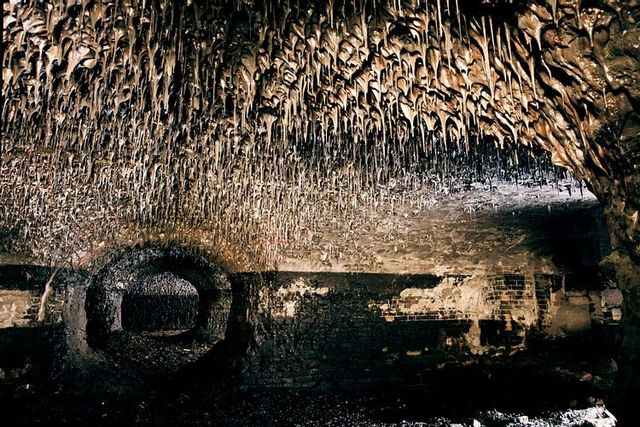
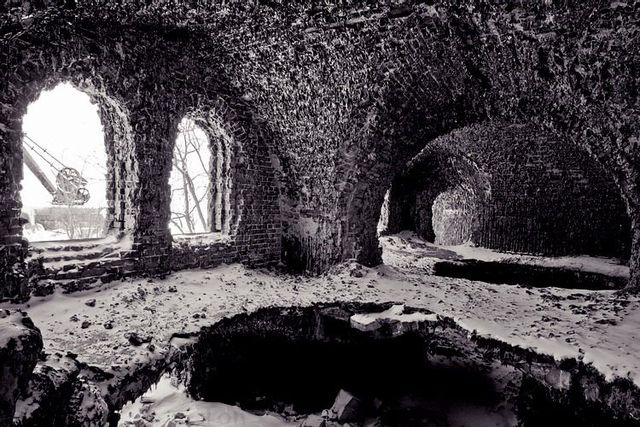
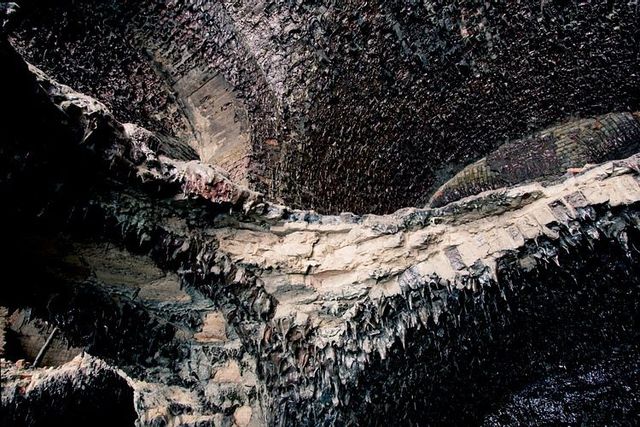
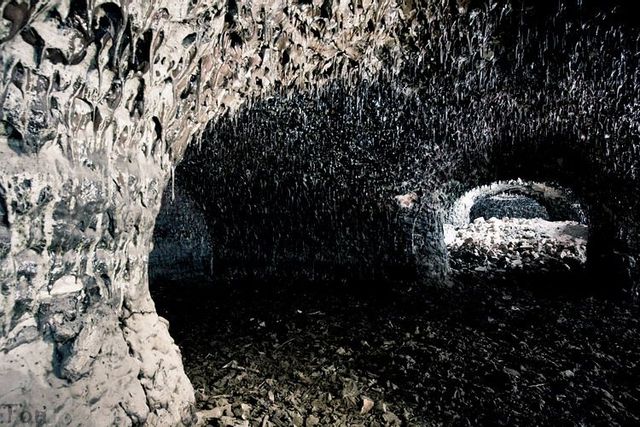
 Bai was traveling the area in 1996, and described a lifeless lake surrounded by cone-shaped hills. The cave appeared to have been artificially dug, and was triangular, about six meters deep. Nearby were two similar caves, but they had collapsed and could not be entered. But what struck Bai was the array of manufactured metal pipes protruding up through the floor of the cave and embedded within its walls, one 40 cm wide. Following their path outside, Bai discovered more pipes protruding from the surface of the conical hill, and even more of them 80 meters away from the cave along the shore of the lake. Excited, he removed a sample and sent it to the Ministry of Metallurgical Industry. The result was 92% common minerals and metals, and 8% of unknown composition.
Bai proceeded about 70 kilometers to the Delhi branch of China's Purple Mountain Observatory, a high vantage point from where he knew he could get a birds-eye view of the whole region. He saw great expanses of flat, open terrain, and putting two and two together, he concluded that this would make for a fine alien landing site. Unknown minerals and plentiful landing space meant that the Baigong Pipes had to be of alien origin.
Scientists from the China Seismological Bureau visited the lake in 2001 to examine the pipes. Samples brought back to the Beijing Institute of Geology were examined by thermoluminescence dating, a technique that can determine how long it's been since a crystalline mineral was either heated or exposed to sunlight. The result came back that if these were indeed iron pipes that had been smelted, they were made 140-150,000 years ago. Human history in the region only goes back some 30,000 years, and so the alien theory seemed to have been confirmed. The following year the Xinhua news story was published, and the Baigong Pipes entered pop culture as, supposedly, genuine, tangible evidence of alien visitation.
If you visit the area today, you'll find a locally-built monument to the aliens off the main highway, replete with a mockup metallic satellite dish. Internet forums buzz with the absence of followup articles by Xinhua; the natural conclusion is that it turned out the alien explanation was the true one and the Chinese government is suppressing any further reporting. Cracked.com touts the Baigong Pipes as one of Six Insane Discoveries that Science Can't Explain.
And although that's where most reporting of the Baigong Pipes stops, it's also where responsible inquiry should begin. When you settle on a paranormal explanation, it means you've decided there is no natural explanation. In fact, when you don't yet know the explanation, you don't yet know the explanation; so you can't reasonably decide that the time is right to stop investigating. But so many do.
Skeptical hypotheses have already been put forward, seeking a natural explanation for the Baigong Pipes that doesn't require the introduction of a wild assumption like alien visitation. The first thing we turn to are geological processes that might explain them. The Chinese have put forth several such hypotheses, including one involving the seepage of iron-rich magma into existing fissures in the rock.
 A 2003 article in Xinmin Weekly described how this might work. Fractures caused by the uplift of the Qinghai-Tibet plateau could have left the ground riddled with such fissures, into which the highly pressurized magma driving the uplift would have been forced. Assuming this magma was of the right composition that, when combined with the chemical effects of subsequent geological processes, we might very likely expect to see such rusty iron structures in the local rock. But evidence of this has never surfaced, and the Chinese dismissed this theory. They also noted that the Qaidam oil field would not be able to exist if there were active volcanism in the area as recently as 150,000 years ago.
It was their next theory that ultimately led to a satisfactory explanation, and this theory involved the same hypothesized fissures in the sandstone. But, instead of being filled with iron-rich magma, the fissures could have been washed full of iron-rich sediment during floods. Combined with water and the presence of hydrogen sulfide gas, the sediment could have eventually hardened into the rusty metallic pipelike structures of iron pyrite found today. This theory was not fantastic, in part because there was no logical reason why the sandstone might happen to be laced with pipe shaped fissures. But the idea of flooding did make sense, given the geological history of the Qaidam Basin.
Three years before Bai Yu took his first peek into the cave at Lake Toson, researchers Mossa and Schumacher wrote in the Journal of Sedimentary Research about fossil tree casts in Louisiana. They found cylindrical structures in the soil, thermoluminescence dated from 75-95,000 years ago. The chemical composition of the cylinders varied depending on where and when they formed and in what type of soil. The authors found that these were the fossilized casts of tree roots, formed by pedogenesis (the process by which soil is created) and diagenesis (the lithification of soil into rock through compaction and cementation). The result of this process was to create metallic pipelike structures, which by comparing the descriptions offered by researchers, appear to be a perfect match for the Baigong Pipes.
The Chinese scientists eventually did come to the same conclusion, according to the Xinmin Weekly article. They used atomic emission spectroscopy to conduct a detailed chemical analysis of the rusty pipe fragments, and found them to contain organic plant matter. Under the microscope they found tree rings, consistently throughout the samples. Once they established that the Baigong Pipes were simply fossilized tree casts, they set about to discover how they got there.
The Qaidam basin was once a vast lake, which has disappeared as the Qinghai-Tibet plateau uplifted the basin to its current elevation of about 2800 meters. Over the millennia, various floods filled the sink with runoff, alluvium, and debris including such fossils. They can now be found wherever such ancient flows deposited them, and it seems that Bai Yu was lucky enough to discover just such a pocket.
And so we end up with a complete story of how rusty iron pipes, tens of thousands of years older than any people who might have forged them, can end up embedded in solid sandstone in such a way as to baffle the average observer. Like many amateur researchers, Bai Yu stumbled upon an extraordinary discovery, but through his lack of applicable knowledge, misinterpreted what he saw. Those who underestimate the Earth's ability to produce fascinating effects are often left to grope for goofy explanations like alien construction projects. I find that the Baigong Pipes are one of the better examples of the folly of stopping at the paranormal explanation, compared to the rich rewards offered by following the scientific method to uncover what's really going on.
Should you happen to visit Tibet anytime soon, be sure to stop by the city of Delingha. It's a town of most extraordinary beauty, nestled on the edge of the Qaidam Basin below a range of Himalayan hills. There you'll find the local residents proudly displaying their most famous distinction. For a few yuan you can probably get someone to take you to see it. Only a short journey outside of town is said to be a cave, and in this cave are a series of ancient metal pipes.
 These pipes predate all known history, and are embedded into the rock itself. They are said to lead through the very mountain, and connect to a nearby salt lake. The explanation? Ruins of a construction project 150,000 years ago, by alien visitors.
The Baigong Pipes are an example of what paranormal enthusiasts refer to as "out of place artifacts", modern objects discovered in ancient surroundings. The Baigong Pipes are described as a sophisticated system of metal pipes, buried in geology in such a way that precludes the possibility of having been installed in modern times. They are located on Mt. Baigong in the Qinghai province of China, about 40 kilometers southwest of Delingha. Most accounts describe a pyramid-shaped outcropping on the mountain, and the cave containing the pipes is on this pyramid. 80 meters from the mouth of this cave is a salt lake (the twin of an adjacent freshwater lake), and more pipes can be found poking up along the shore. Most of the information you can find online about the Baigong Pipes appears to be originally sourced from a 2002 article from the Xinhua News Agency, talking about preparations by a team of scientists about to embark to this remote area to study the pipes. "Nature is harsh here," said one. "There are no residents let alone modern industry in the area, only a few migrant herdsmen to the north of the mountain."
The two lakes are broad, shallow sinks at the low point of the vast Qaidam Basin. Searching for Mt. Baigong is likely to be fruitless: First, the area is largely flat and the nearest mountains are 20 or 30 kilometers away; second, baigong is a local word for hill and could mean anything in this context. The southernmost of the two lakes, Toson Hu or Lake Toson, has some low bluffs here and there along its southern and western sides (Google Maps link), and it is in one of these bluffs (about 50 or 60 meters in height) that author Bai Yu once happened to find what he described as a small cave, according to his book Into the Qaidam.
 Bai was traveling the area in 1996, and described a lifeless lake surrounded by cone-shaped hills. The cave appeared to have been artificially dug, and was triangular, about six meters deep. Nearby were two similar caves, but they had collapsed and could not be entered. But what struck Bai was the array of manufactured metal pipes protruding up through the floor of the cave and embedded within its walls, one 40 cm wide. Following their path outside, Bai discovered more pipes protruding from the surface of the conical hill, and even more of them 80 meters away from the cave along the shore of the lake. Excited, he removed a sample and sent it to the Ministry of Metallurgical Industry. The result was 92% common minerals and metals, and 8% of unknown composition.
Bai proceeded about 70 kilometers to the Delhi branch of China's Purple Mountain Observatory, a high vantage point from where he knew he could get a birds-eye view of the whole region. He saw great expanses of flat, open terrain, and putting two and two together, he concluded that this would make for a fine alien landing site. Unknown minerals and plentiful landing space meant that the Baigong Pipes had to be of alien origin.
Scientists from the China Seismological Bureau visited the lake in 2001 to examine the pipes. Samples brought back to the Beijing Institute of Geology were examined by thermoluminescence dating, a technique that can determine how long it's been since a crystalline mineral was either heated or exposed to sunlight. The result came back that if these were indeed iron pipes that had been smelted, they were made 140-150,000 years ago. Human history in the region only goes back some 30,000 years, and so the alien theory seemed to have been confirmed. The following
 year the Xinhua news story was published, and the Baigong Pipes entered pop culture as, supposedly, genuine, tangible evidence of alien visitation.
If you visit the area today, you'll find a locally-built monument to the aliens off the main highway, replete with a mockup metallic satellite dish. Internet forums buzz with the absence of followup articles by Xinhua; the natural conclusion is that it turned out the alien explanation was the true one and the Chinese government is suppressing any further reporting. Cracked.com touts the Baigong Pipes as one of Six Insane Discoveries that Science Can't Explain.
And although that's where most reporting of the Baigong Pipes stops, it's also where responsible inquiry should begin. When you settle on a paranormal explanation, it means you've decided there is no natural explanation. In fact, when you don't yet know the explanation, you don't yet know the explanation; so you can't reasonably decide that the time is right to stop investigating. But so many do.
Skeptical hypotheses have already been put forward, seeking a natural explanation for the Baigong Pipes that doesn't require the introduction of a wild assumption like alien visitation. The first thing we turn to are geological processes that might explain them. The Chinese have put forth several such hypotheses, including one involving the seepage of iron-rich magma into existing fissures in the rock.
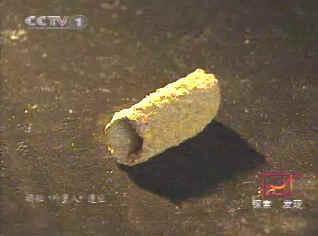 A 2003 article in Xinmin Weekly described how this might work. Fractures caused by the uplift of the Qinghai-Tibet plateau could have left the ground riddled with such fissures, into which the highly pressurized magma driving the uplift would have been forced. Assuming this magma was of the right composition that, when combined with the chemical effects of subsequent geological processes, we might very likely expect to see such rusty iron structures in the local rock. But evidence of this has never surfaced, and the Chinese dismissed this theory. They also noted that the Qaidam oil field would not be able to exist if there were active volcanism in the area as recently as 150,000 years ago.
It was their next theory that ultimately led to a satisfactory explanation, and this theory involved the same hypothesized fissures in the sandstone. But, instead of being filled with iron-rich magma, the fissures could have been washed full of iron-rich sediment during floods. Combined with water and the presence of hydrogen sulfide gas, the sediment could have eventually hardened into the rusty metallic pipelike structures of iron pyrite found today. This theory was not fantastic, in part because there was no logical reason why the sandstone might happen to be laced with pipe shaped fissures. But the idea of flooding did make sense, given the geological history of the Qaidam Basin.
Three years before Bai Yu took his first peek into the cave at Lake Toson, researchers Mossa and Schumacher wrote in the Journal of Sedimentary Research about fossil tree casts in Louisiana. They found cylindrical structures in the soil, thermoluminescence dated from 75-95,000 years ago. The chemical composition of the cylinders varied depending on where and when they formed and in what type of soil. The authors found that these were the fossilized casts of tree roots, formed by pedogenesis (the process by which soil is created) and diagenesis (the lithification of soil into rock through compaction and cementation). The result of this process was to create metallic pipelike structures, which by comparing the descriptions offered by researchers, appear to be a perfect match for the Baigong Pipes.
The Chinese scientists eventually did come to the same conclusion, according to the Xinmin Weekly article. They used atomic emission spectroscopy to conduct a detailed chemical analysis of the rusty pipe fragments, and found them to contain organic plant matter. Under the microscope they found tree rings, consistently throughout the samples. Once they established that the Baigong Pipes were simply fossilized tree casts, they set about to discover how they got there.
The Qaidam basin was once a vast lake, which has disappeared as the Qinghai-Tibet plateau uplifted the basin to its current elevation of about 2800 meters. Over the millennia, various floods filled the sink with runoff, alluvium, and debris including such fossils. They can now be found wherever such ancient flows deposited them, and it seems that Bai Yu was lucky enough to discover just such a pocket.
And so we end up with a complete story of how rusty iron pipes, tens of thousands of years older than any people who might have forged them, can end up embedded in solid sandstone in such a way as to baffle the average observer. Like many amateur researchers, Bai Yu stumbled upon an extraordinary discovery, but through his lack of applicable knowledge, misinterpreted what he saw. Those who underestimate the Earth's ability to produce fascinating effects are often left to grope for goofy explanations like alien construction projects. I find that the Baigong Pipes are one of the better examples of the folly of stopping at the paranormal explanation, compared to the rich rewards offered by following the scientific method to uncover what's really going on.